


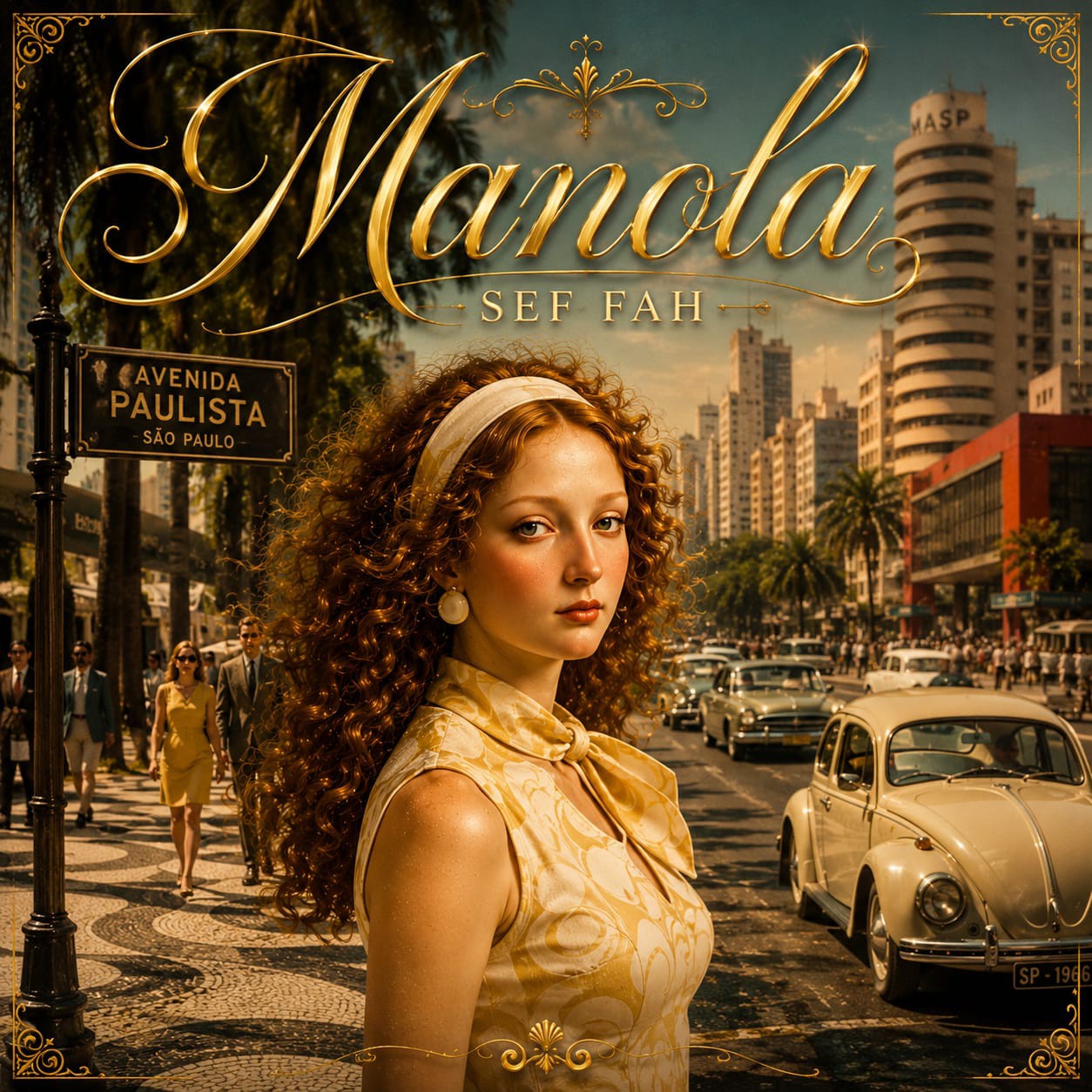
For Sef Fah, music does not always begin with an instrument, a studio session, or even a clear idea. Sometimes, it simply appears. She describes the experience as having a radio inside her head that suddenly switches on, bringing lyrics, melody and arrangement together at once. She does not always know where these songs come from, but when they arrive, they can feel completely formed.
This unusual relationship with music has shaped both her creativity and her challenges. Sef Fah has an exceptional memory for melodies and can remember music after hearing it only once. Yet while the songs may sound precise in her mind, explaining exactly what she hears to other musicians can be much harder. She knows the feeling and the sound she wants, but does not always have the technical language to describe every instrument or arrangement. For her, the real challenge is often not creating the song, but finding a way to reproduce what already exists in her imagination.
Sef Fah also speaks about a moment in her thirties that she feels changed everything. After meeting a healer almost by chance, she experienced what she describes as a sudden opening, after which music began arriving with a new intensity. She does not claim to fully understand what happened, but the experience left her questioning whether this part of her creativity had always been there.
That creative journey eventually led to “Manola,” a song that began as an exercise in imagining what she might write for Madonna. What started on a train as a simple creative experiment slowly became its own world. Madonna eventually became Manola, a fictional woman connected to 1960s São Paulo, Botticelli, Brazilian culture and Sef Fah’s own fascination with art and memory.
Her love of artists such as Caetano Veloso, Seu Jorge and Leonard Cohen also reveals how naturally her ideas move across cultures and musical styles. She has explored different languages for her songs, while discovering that translation in music is about much more than changing words. The melody, rhythm and meaning must still feel right.
In this interview, Sef Fah opens up about the mysterious way her songs arrive, the difficulty of translating inner music into sound, her creative use of AI, and the many artistic connections behind “Manola.” It is a conversation about music, imagination, art and the strange places where inspiration can begin.
You describe songs sometimes arriving in your head almost like a radio suddenly switching on, with lyrics, melody and even parts of the arrangement appearing together. What is that experience actually like for you in the moment, and after living with it for some time, have you come to understand where these songs might be coming from creatively?
I don’t really know where they come from. For me, it is like having a radio inside my head. Suddenly, a song is there. The lyrics, the melody and the arrangement always arrive together. It is not something I build slowly. It is instant. It is synchronicity.
When I was 33, a friend took me to see a healer. I didn’t want to go at all. There were hundreds of people there, and he worked on a donation basis. He put his hand on my head for maybe five seconds and said, “Oh, I’ve made the connection.” I thought he was joking.
What makes this strange is that, before I ever met him, I had a very strange obsession that I wasn’t even consciously aware of. I would imagine that if a killer came to me and said, “Write a song now, or I will kill your family,” I would be unable to write one, and I would actually see my family being killed. It wasn’t really a nightmare. It was more like an unconscious blockage that I didn’t understand.
After seeing the healer, something seemed to open, and it opened very suddenly, almost violently. I started hearing music. Sometimes I wonder whether I might have been a musician before and somehow that part of me had been blocked. I obviously don’t know if that is true, but something definitely changed.
I am not a musician in the traditional sense, but I have an extraordinary memory for music. I can hear something once and remember it for years. I once had a friend who was a songwriter in France. He woke me up at five in the morning while I was in Montreal and, because he was drunk, he sang me a song over the phone. He sang the lyrics and melody only once. Years later, I could still remember it, while he couldn’t remember his own song. Luckily, he had written the lyrics on a cardboard plate, and eventually he found it and realised I was right.
That is also why I have always been very careful about singing my own songs out loud. I know that if I hear a melody, even once, I can remember it.
The strange thing is that what I hear in my head is incredibly precise. It is almost like hearing a song that is already famous. Imagine a children’s song that everybody knows. You cannot simply change the melody and still feel that it is the same song. That’s how my songs feel to me. Nobody else knows them, but inside my head they already exist.
That is why working with musicians can be difficult. They naturally want to improve things or change something, and sometimes people have thought I was being arrogant because I wouldn’t accept the changes. But when I hear a song in my head, it is so precise that changing it doesn’t feel possible. It is not really a question of whether I like the change. It simply isn’t the song I hear.
My biggest difficulty has always been the orchestration. I can hear it very clearly, but because I am not a musician, I cannot always analyse exactly what I am hearing. I know solfège and I have many songs written down, but translating what I hear into musical language is very difficult. Sometimes I can spend hours trying to explain one sound that I can hear instantly.
That is why AI has been a Godsend for me. I can try a hundred different orchestrations and keep searching until I find something close to what I hear in my head.
When “Manola” came to me on the train, it was really just an exercise in style. I admire people who can write songs for other artists, so I was sitting there thinking, “If I had to write a song for someone very famous, what would I write?”
I was bored, and suddenly the whole song arrived: the lyrics and the melody.
I never thought it was an important song. I thought it was a spiritual song, a little sad and mysterious. I particularly liked the idea at the heart of it: a woman thinking about her life, what she has brought to other people, what she has given and what she has left behind. And I think that is something that concerns every human being on this planet.
I don’t really know why this particular song stayed with me. Sometimes I remember the songs that come to me, and sometimes I forget them.
Even when I have my mobile phone with me, I don’t always have the time to record a song when it comes. Sometimes it happens when I’m doing something and I simply can’t stop. Then the song is gone, and if I really liked it, that can make me anxious because I don’t know if it will come back.
It was recorded professionally in a recording studio with a pianist and my voice, and I protected the song, even though it was never really meant to be a song for me. It was written for someone else, and I honestly don’t know why I decided to record it myself at the time.
There’s often a big gap between hearing a complete musical world internally and explaining it to musicians. What have those failed attempts taught you about the difference between hearing music and communicating it?
I think it is very easy when you have a good level of musical knowledge, when you are a good musician. You have the musical technique to understand and reproduce what you are hearing. It is much more difficult when you are a non-musician, hearing music almost like a radio station in your head.
I can remember the lyrics and the melody very precisely. But when it comes to the orchestration, I don’t even know if I hear individual instruments. I hear the music, but I don’t necessarily hear, “Oh, that’s a violin, that’s a piano, that’s a guitar.” I hear the whole sound without necessarily knowing what is producing it. And that is probably why it is so difficult for me to explain it to a musician. I know what I want to hear, but I don’t necessarily know how to describe it.
I had actually thought about this long before I started experiencing it myself. I used to wonder about the chicken and the egg. The person who invented the violin, did they hear the violin before? Did they create the violin because they were hearing it? And the person who built the first bell, were they hearing the sound before they made the bell? Did they hear the sound and then make the bell?
I have also experienced something that made me think about this even more. Once, a friend and I both heard crystal bells and a very high-frequency sound, when neither of us had been drinking or taking drugs. It sounded like a choir of angels to both of us. Someone from another religion might describe or understand exactly the same sound in a completely different way.
It makes me wonder whether sometimes we hear something first and then try to find a way to reproduce it. Maybe that is also what happens with music in my head. Perhaps I am not hearing individual instruments at all. Perhaps I am hearing a musical sound without knowing what instrument should produce it, and then I have to find a way to reproduce it.
I remember something from when I was a teenager that I understand very differently now. I knew a very important and very eccentric classical concert performer. One day he said to me, “Songwriters have no merit. They just piss. We are the technicians who have the merit, because we have to reproduce what they hear and compose, but they have no merit.”
At the time, I thought it was completely crazy. I remember thinking, “This is completely ridiculous,” especially because he was such an intelligent man. But now, after my own experience, I understand what he meant much more.
Of course, there is another side to it. The musicians and composers of that time had the merit of knowing how to write music, read scores and play instruments. They had the technical ability to take what was in their head and put it onto paper and reproduce it.
So it becomes complicated. In my case, the song arrives, but I don’t have the same technical ability to translate everything I hear into music. The difficult part for me is not the song arriving. It is reproducing what I hear.
There is also another reason why I don’t always go through the whole process. I can be very lazy, and I don’t see myself as an important person. I don’t see my music as something terribly important either. I’m certainly not walking around thinking I’m Mozart! Sometimes I can simply think, “Who am I to spend all this time doing this?” and let it go.
There have been times when I worked with a musician and spent a very long time writing the music down on sheets of music, trying to get what I was hearing into a form that could be reproduced. I have done it, and sometimes it took a very long time. But other times I just think, “It’s not such a big deal,” and I don’t do it.
And that is why AI has been such a help to me. It gives me the energy to actually do it. I can sit there and experiment with the music without needing another person to help me every step of the way. And it is not costly in the same way.
Because music is very expensive. If I have to hire someone to help me write the music down, explain what I am hearing, arrange it and try to reproduce it, it can cost a lot of money. And sometimes it takes a very long time.
Madonna and Seu Jorge are both references you’ve mentioned when talking about your creative world. What do those artists represent to you, and how do they open up possibilities for where your own music can go?
Now I have translated “Manola”, and some other songs that I have, into Portuguese. I became a little obsessed with Seu Jorge translating David Bowie’s songs, and I also really love Brazilian music. I love translating my songs into other languages. It is much easier to do now because of the possibilities with translation, but finding the right translation is still not easy.
For example, when I translate from French into English, I have to rewrite the song myself in English. I cannot use an internet translator; it doesn’t work. The words might be translated correctly, but the song doesn’t work anymore. The melody, the rhythm and the meaning have to work together. Portuguese took me a long time too because I tried many different translations before finding the right one.
When I sing a song in Portuguese, the melody changes a little because the words are different. Sometimes a song comes directly to me in English, like “Manola”, which originally came to me in English. Sometimes I translate a French song into another language. So it depends on the song. But in the case of “Manola”, the Portuguese version is a translation of an English song.
It was an exercise in style: I wanted to imagine writing a song for a famous person. I picked Madonna, but I could have picked someone else, and I would have done the same exercise. I was sitting on a train, and that is how the song arrived.
If you have to write a song for someone, I think you have to try to connect with their soul. In this case, the way I imagined Madonna for the purpose of the exercise connected in my mind with Frida Kahlo and Evita. I’m not saying that this is the truth about Madonna. It is simply how I perceived her for this particular creative exercise.
I really like Madonna in Evita. I thought she was fantastic in that role, and she received a Golden Globe for it. So I think there is something in the style of “Manola” that is slightly reminiscent of Evita.
The song came to me in English, but I think it would be great to hear it sung in Spanish or Portuguese.
I can also imagine her in a duet with someone with a mature, sensual presence, like Seu Jorge, even though he is younger than her.
My two favourite Brazilian singers are Caetano Veloso and Seu Jorge, and of course I love many other Brazilian singers and musicians. I especially love the Tropicalismo music movement of the 1960s.
I also love Leonard Cohen, and the orchestration I found for “Manola” makes me think of some Leonard Cohen songs that I like a lot. Some people might find “Manola” slow, but actually that is what I really like about this version. I like the atmosphere and the fact that it takes its time.
But in two weeks, I will release a 1960s version of “Manola”, which is much more energetic, joyful and made for dancing. So it will be interesting to have these two very different versions of the same song.
Why did you choose the name “Manola” and create a fictional character rather than keeping the song as “Madonna”? What does Manola represent to you?
Originally, the song was called “Madonna” in English. It was written as an exercise in style, imagining a song for Madonna. I recorded it professionally with my voice, a pianist and orchestration, mainly to protect the song. But the result wasn’t really what I had heard in my head, because the song wasn’t really meant for me.
Later, I started thinking about translating it. First I had a Spanish version, and then I worked on a Portuguese version. Eventually, I put it into AI and started experimenting with the orchestration and the voice.
Somewhere along the way, Madonna became Manola. And now I am very attached to Manola, this new girl. I really like this Manola that I am trying to build in my head. She has become something else for me. Manola can be anyone.
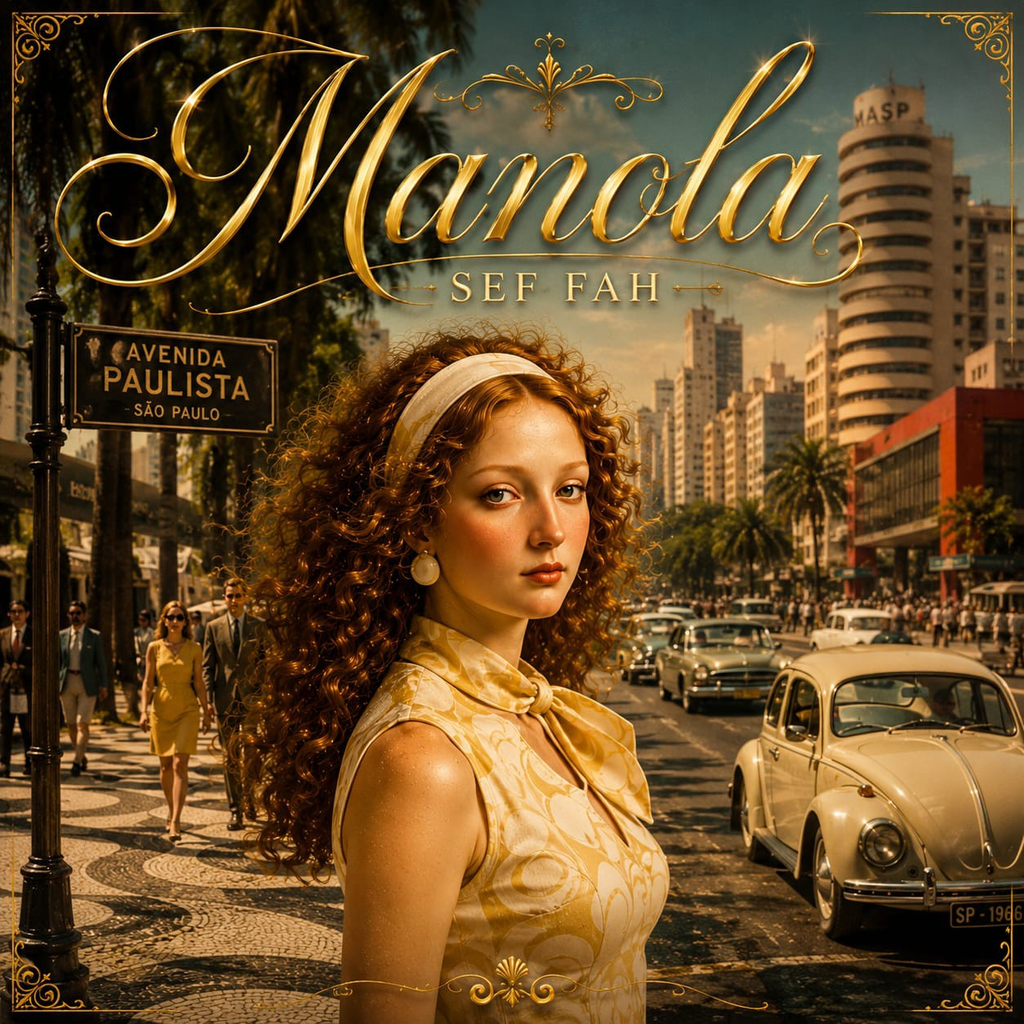
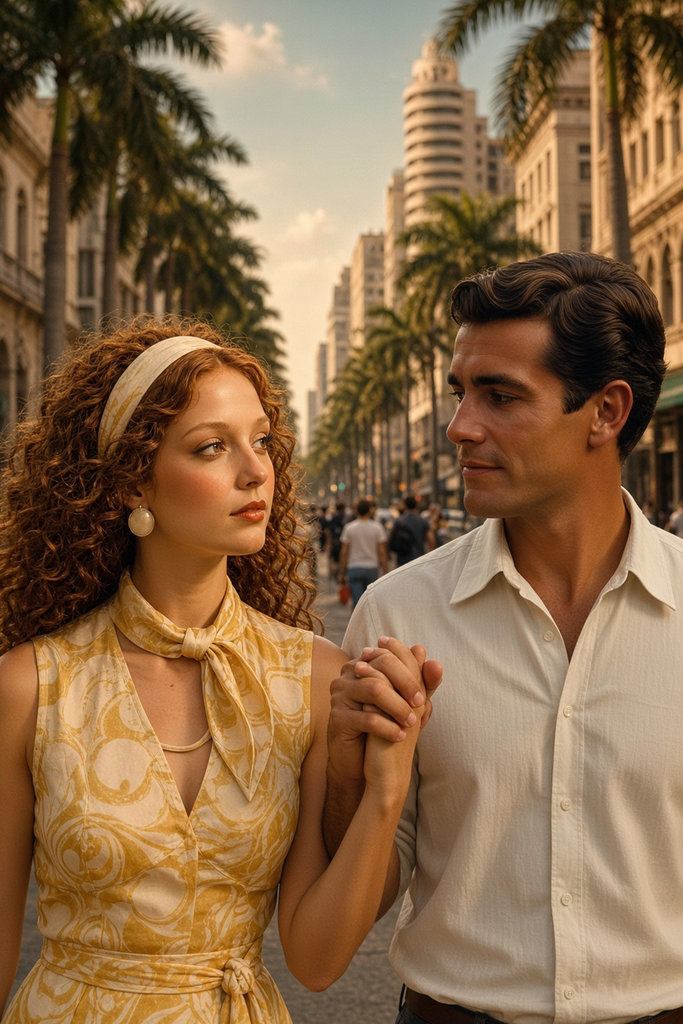
She is from the 1960s, very classical. And now there are two Manolas, because there is the Manola from this release and another, slightly younger Manola, coming in two weeks. They are two different women, but they both exist in the São Paulo of the 1960s that I have in my head.
The Manola from this release is the one connected with Botticelli. The Manola coming in two weeks is different. She is more like a pin-up from the 1960s, but still very classical. She makes me think of old magazines and book covers from that period. Even her face comes from a kind of 1970s drawing.
And now Manola is very powerful for me. This Manola from the 1960s has become very important to me and is really a source of inspiration for me.
I also found her face because I have always been fascinated by Botticelli. My fascination with Botticelli goes back to when I was 14. I went to Florence and visited the Uffizi Gallery, where there are so many Botticelli paintings. Something very strange happened to me there. I became completely absorbed. I stayed in front of the paintings for about four hours without moving. I was almost hypnotised. I felt as if I had left time completely.
There is actually a name for this kind of experience, Stendhal syndrome, which is associated with becoming overwhelmed by art in Florence. It is a real phenomenon that has been discussed medically, although I don’t know whether you can really call it a disease. For me, it was very real.
So originally, Manola had a Botticelli face. In the image, it is almost like a Botticelli girl transposed into 1960s São Paulo.
It is a little complicated. But my head is complicated! I’m laughing, but it really is complicated in my head, all these connections. For Madonna, my sources of inspiration were Evita and perhaps also Frida Kahlo. But now, for Manola, my sources of inspiration are Botticelli and São Paulo in the 1960s.
I think this is how the brain works. We are always making connections that we don’t even understand.
