


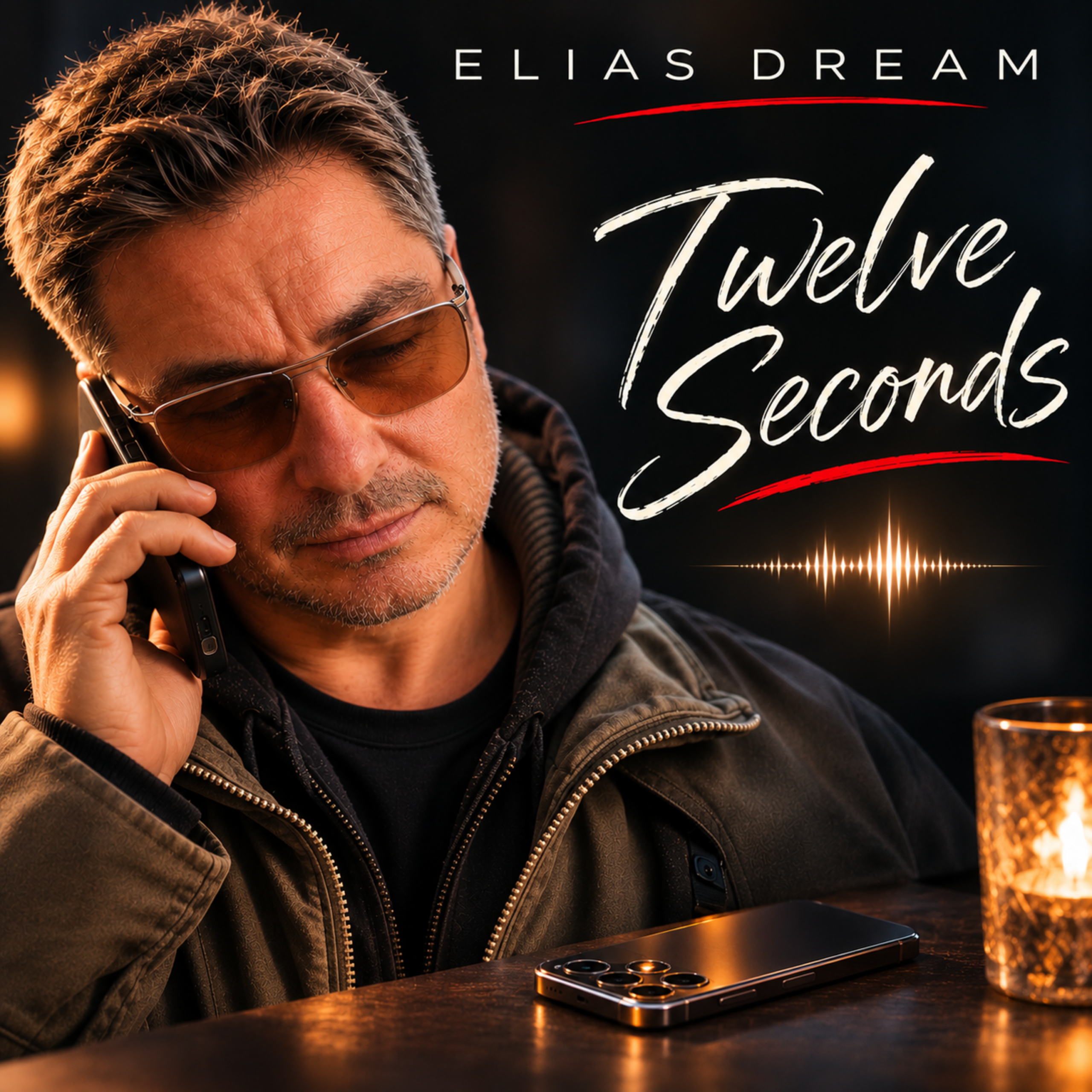
Some songs begin with a melody, while others start with a question that refuses to go away. For Elias Dream, songwriting is often about imagining the lives behind ordinary moments and turning those thoughts into stories listeners can see, feel and recognize. His latest release, “Twelve Seconds,” grew from a simple but deeply moving idea: what would it mean to hear the voice of someone you had lost, even if you were given only twelve seconds? It is an emotionally thoughtful piece that explores grief, memory and the extraordinary value of moments we often take for granted.
Rather than approaching songwriting through a single genre or musical formula, Elias Dream has developed a sound shaped by melodic vocals, spoken rap, rock influences and cinematic arrangements. His musical background stretches back to childhood, growing up in a household where creativity was already part of everyday life. With a father who played in a band, a mother with a ballet background and piano lessons forming part of his early years, music became a natural part of his world. Those diverse influences continue to inform his approach, allowing him to choose the sound that best serves each story rather than confining himself to one musical identity.
That storytelling instinct is particularly evident in “Twelve Seconds.” The idea emerged while he was working on another song, “Goodbye,” and began imagining the emotional world of a man who had lost someone he loved. He thought about the everyday things that suddenly become precious after a loss: a familiar voice, a shared laugh, a phone call or an ordinary conversation. From there came the central image of someone being able to hear the voice of a departed loved one for just twelve seconds. Although the song is a fictional story, its emotional impact became increasingly personal as he worked on it.
During the writing process, Elias Dream was also reflecting on his father, who had suffered a stroke and had been living in a nursing home. The experience brought the song’s message closer to home, prompting him to visit his father more often and reconsider how easily people postpone time with those they love. It is this connection between imagined stories and genuine human experiences that gives his songwriting much of its emotional depth.
Elias Dream approaches his compositions almost like short films, visualising the characters, locations and small details before deciding how the music should unfold. He typically completes the lyrics first, building the story before finding the appropriate arrangement. His use of spoken verses allows him to communicate like a storyteller, while melodic choruses provide space for the emotions to rise. The Hammond B3 organ is another distinctive part of his musical palette, bringing warmth and a slightly melancholic character to arrangements when the story calls for it.
His songwriting also reaches beyond his own experiences. Songs such as “You Survived” were inspired by the personal struggles shared by someone close to him, demonstrating his interest in giving a voice to experiences that might otherwise remain unheard. For Elias Dream, the most rewarding part of making music is hearing from listeners who recognise their own memories and emotions in his songs. Whether a track brings back a forgotten experience or simply makes someone feel less alone, that connection matters more to him than numbers or streams.
With another story already taking shape around the difficult subject of domestic violence, Elias Dream shows no intention of limiting the conversations his music can explore. His focus remains on creating songs that encourage reflection, challenge perspectives and connect with people through honest storytelling. In “Twelve Seconds,” he offers a gentle but powerful reminder that the smallest moments with the people we love can become our most treasured memories, and sometimes the most important thing we can do is appreciate them while they are still within reach.
“Twelve Seconds” explores the emotional experience of hearing the voice of someone you have lost, even if only for a brief moment. What inspired you to write this song, and was there a particular memory or experience that first brought the idea to life?
The idea for “Twelve Seconds” actually came to me while I was working on another song of mine called “Goodbye.”
I started wondering how the man in that story might feel after losing someone he loved. What would his everyday life look like? What would he miss the most?
And that’s when I started thinking about all those little things we usually take for granted. Like hearing someone’s voice, their laughter, or just a few ordinary words.
Then this thought crossed my mind: What if someone could hear the voice of a person they’d lost, even if it was only for twelve seconds?
That idea really stuck with me.
“Twelve Seconds” isn’t a sequel to “Goodbye.” It’s a completely separate story, but it grew out of those same thoughts about love, loss, and the memories we hold on to.
I guess that’s how a lot of my songs begin. One story gets me thinking, and before I know it, another one starts taking shape.
The song focuses on the small moments we often overlook until they become memories we wish we could experience again. Why was this message important for you to share, and what do you hope listeners reflect on after hearing it?
I think we all have this habit of taking the little things in life for granted.
A phone call, having coffee together, hearing someone laugh, or just listening to a familiar voice.
We don’t really think about those moments because we assume there will always be another one tomorrow.
But sometimes there isn’t.
And suddenly, those ordinary little things become the memories we’d give anything to experience just one more time.
That’s really what “Twelve Seconds” is about for me.
I don’t want to tell people how they should live their lives. That’s not my place.
But maybe someone will hear the song and think about a person they haven’t talked to in a while.
And maybe they’ll pick up the phone and give that person a call.
If my song makes even one person do that, I think that’s something pretty special.
You describe your songs as stories that unfold like short films. How do you approach songwriting when you want listeners to experience a story rather than simply hear you describe an emotion?
That’s actually a pretty good way to describe how I write songs.
When I come up with an idea, I usually see the story in my head almost like a movie.
I imagine the people, where they are, what they’re doing, and most importantly, what they’re feeling.
With “Twelve Seconds,” for example, I pictured a man sitting alone at night, holding on to an old phone because it’s one of the few things he has left of someone he loved.
I try to put myself in that person’s shoes.
What would I be thinking? What would I do? What little details would matter to me?
I think those details are what make a story feel real.
Instead of just telling someone that a person is grieving, I’d rather show them what that grief looks like in everyday life.
And if I can make someone picture that scene while listening to my music, then I’ve done what I wanted to do.
Your music brings together melodic vocals, spoken rap, rock influences, and cinematic production. How did you develop this combination of styles, and which influences have helped shape the Elias Dream sound?
Music has been part of my life for as long as I can remember.
My father played in a band, my mother came from a ballet background, and I took piano lessons when I was a kid.
So I grew up around music, and I guess it just became a natural part of who I am.
Over the years, I’ve listened to all kinds of music. Rock, soul, pop, and later on, rap.
And I never really wanted to limit myself to just one genre.
That’s probably why my songs sometimes have spoken rap verses, soulful melodies, a little rock influence, and these bigger, almost cinematic moments.
For me, the story comes first.
If a song needs a quiet piano, that’s what I’ll use. If it needs stronger drums, a warm organ, or a powerful chorus, I’ll go in that direction.
I don’t sit down and think, “Okay, today I’m going to make a song that fits perfectly into this genre.”
I just try to find the sound that feels right for the story.
The Hammond B3 organ is a distinctive part of your musical identity, adding warmth and an organic character to your arrangements. What attracts you to this instrument, and how do you decide when it is right for a particular song?
I’ve always loved the sound of a Hammond organ.
There’s something about it that’s warm, a little rough around the edges, and incredibly expressive.
And here’s a funny little story: I actually own a real Hammond B3!
I found it through a classified ad here in Germany and managed to get it for an unbelievably low price.
It’s a beautiful old instrument.
The only problem is that my Hammond doesn’t have a direct connection to my computer, so when I’m producing my songs, I usually recreate that sound with a synthesizer.
What I love most is how the Hammond can add emotion without taking over the whole song.
Sometimes just a few notes between two vocal lines can say more than a whole arrangement.
I especially like those warm, slightly melancholic sounds.
But I don’t want to put a Hammond into every song just because I like it. It has to fit the story.
When it does, though, I think it adds something really special.
“Twelve Seconds” deals with grief, memory, and the things we wish we had said while we still had the chance. Was it emotionally challenging to work on a subject this personal, and did the songwriting process change the way you think about loss?
Yes, definitely. And in a way, it became more personal than I originally expected.
When I was working on “Twelve Seconds,” my dad had suffered a stroke and had already been living in a nursing home for quite some time.
The song itself is a fictional story, but writing those lyrics made me think a lot about my own life.
Especially about how quickly things can change and how easily we take the time we have with the people we love for granted.
And something actually happened because of that.
While I was working on the song, I started visiting my dad more often.
I guess writing about losing someone made me realize even more how important it is to spend time with the people who are still here.
So yes, the story may be fictional, but the emotions behind it became very real for me.
And that’s something I’ll always remember about writing this song.
Your music explores love, loneliness, hope, and the fragile nature of human connections. Are these subjects mainly drawn from your own experiences, or do you also find inspiration in the stories and experiences of other people?
It’s definitely a mix of both.
Of course, my own experiences and feelings influence my music, but sometimes it’s someone else’s story that really gets to me.
A good example is my song “You Survived.”
A friend of mine once opened up to me about her childhood and some of the difficult things she’d been through.
And honestly, her story really stayed with me.
I kept thinking about what it must have been like for her growing up, how she must have felt as a little girl, and how those experiences can stay with someone long after childhood is over.
Eventually, I started turning those thoughts into a song.
I didn’t want to just tell her story word for word. I wanted to capture the feelings behind it, especially the loneliness, the pain, but also the strength it takes to keep going.
That’s how “You Survived” came to life.
I think sometimes people carry stories inside them that nobody really knows about.
And if I can give some of those feelings a voice through my music, that means a lot to me.
Not every song is about my own life, but every story I write has to mean something to me. Otherwise, I don’t think I could tell it honestly.
When developing a song, how do you balance the lyrics, vocal delivery, and cinematic production to make sure the music supports the story without taking away from its emotional message?
For me, it always starts with the lyrics.
I usually write the whole story first, before I even start thinking about the music.
I want to know what I’m trying to say, who the people in the story are, and what they’re going through.
Once the lyrics are finished, I start looking for the right sound.
Sometimes it’s a quiet piano, a warm Hammond organ, or just a simple beat. Other times, the story needs something bigger and more dramatic.
I also think a lot about how the words should be delivered.
That’s why I like combining spoken rap with melodic choruses. The spoken parts let me tell the story almost like I’m having a conversation with someone, while the chorus brings out the emotions.
But honestly, getting everything to work together isn’t always easy.
Sometimes I listen to a song and realize the music is doing too much. It might sound great, but it’s taking attention away from the words.
And then I go back and change things.
I’ve learned that sometimes less really is more.
At the end of the day, I don’t want people to just hear a nice melody. I want them to listen to the story and feel something.
You describe music as more than entertainment, seeing it as a way to tell stories that deserve to be heard. What kind of connection would you like to build with your listeners, and how important is it for them to find their own experiences reflected in your songs?
You know, for me, music is about much more than just getting streams or having people listen to my songs.
I want to tell stories that mean something to people.
And honestly, one of the best feelings is when someone takes the time to write to me and tell me how a song affected them.
That’s actually happened quite a few times.
People have told me that my songs touched them, brought back memories, or reminded them of something they’d experienced in their own lives.
And those messages really mean a lot to me.
Sometimes I sit there reading a comment and think, “Wow, I wrote this story sitting at home, and now someone somewhere in the world is connecting with it in such a personal way.”
That’s pretty amazing when you think about it.
I don’t expect everyone to interpret my songs the same way. Everyone has their own memories, experiences, and feelings.
And I actually love that.
If someone hears one of my songs and feels understood, or maybe just a little less alone, then I’ve achieved something that means more to me than any number of streams.
Because at the end of the day, music should connect people, shouldn’t it?
Following “Twelve Seconds,” what other stories or musical ideas are you hoping to explore? Are there any upcoming releases or projects that listeners should look forward to?
Oh, I’ve always got new ideas running around in my head!
And actually, I’m working on a new song right now that deals with a pretty serious subject: domestic violence.
It’s about a man who hears what’s happening in the apartment next door. He knows a woman is being hurt, but he’s afraid to get involved. He wants to help, but he keeps asking himself whether stepping in might actually make things worse.
And that’s what interested me about this story.
We often say that people should help when they see something wrong. But what happens when someone is genuinely scared? When they want to do the right thing but don’t know how?
I wanted to explore that conflict, the fear, the guilt, and eventually the courage it takes to do something.
The story isn’t about some big hero saving the day. It’s about an ordinary person who finally decides he can’t just look away anymore.
I think that’s an important message.
Of course, I also want to keep experimenting with different musical styles. I don’t want every Elias Dream song to sound the same.
But one thing probably won’t change. I want to keep telling stories that make people think and feel something.
And who knows? Maybe one day I’ll surprise everyone with a really happy song!
I’ve still got plenty of stories left to tell.
WEBSITE | FACEBOOK | SPOTIFY | YOUTUBE | INSTAGRAM | TIKTOK | SOUNDCLOUD
