


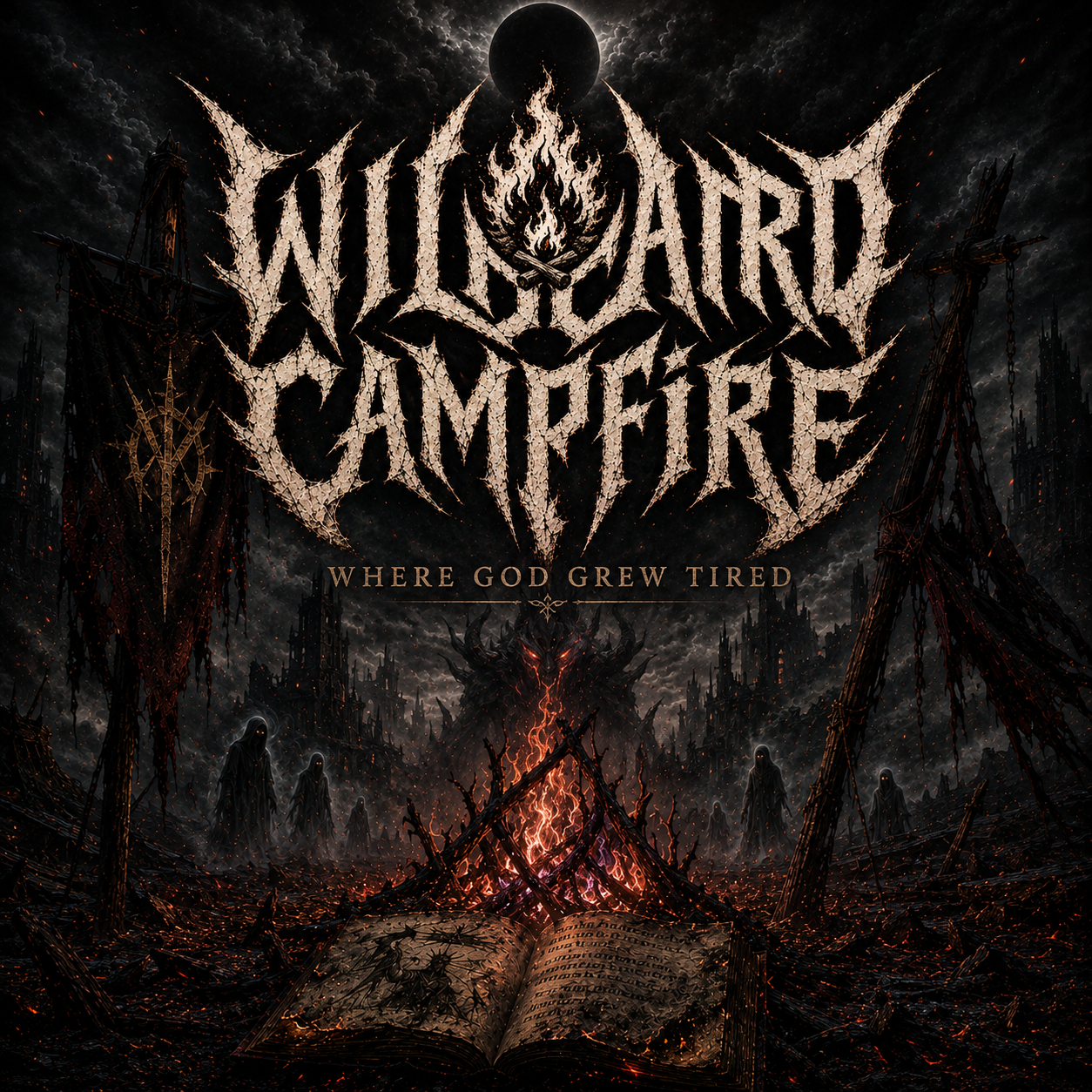
Wildcard Campfire is a project where heavy music meets cinematic soundscapes and imaginative storytelling. Blending crushing guitar riffs, aggressive breakdowns, melodic hooks and atmospheric arrangements, the faceless solo project explores fictional worlds filled with war, faith, personal struggles, forbidden love and the darker sides of human nature.
With Where God Grew Tired, Wildcard Campfire takes this approach further, presenting a ten-track cinematic metal anthology connected by the history of a fictional civilization. Rather than following one continuous storyline, the album offers different perspectives on the same world, allowing each song to stand on its own while contributing to a much larger narrative. At its heart is the three-part “Ashen Gospel” trilogy, which explores how beliefs, power struggles and cycles of hatred can shape civilizations across generations.
Behind the project is a songwriter with more than twenty years of musical experience, bringing together long-held ideas and a passion for creating stories that listeners can explore at their own pace. In this interview, Wildcard Campfire discusses the creative vision behind the project, the balance between musical aggression and emotional depth, the decision to remain faceless, and the lessons learned while building an entire fictional world through music. We also look ahead to a new creative direction that promises to explore dystopian settings, human psychology and the ways people interpret reality.
For people discovering Wildcard Campfire for the first time, tell us about the project, how it came together, and what inspired you to create a faceless, story-driven heavy music project?
To me, Wildcard Campfire is first and foremost a place where I can take ideas, thoughts, and experiences and turn them into music and fictional worlds. I define its sound as Cinematic Heavy Music because I love combining the aggression of heavy music with the depth and atmosphere of cinematic music, without feeling like I have to stick to one particular genre.
I’ve been playing and creating music for over twenty years, and over that time I’ve accumulated quite a few songs, lyrics, and ideas that never made it to the final production stage. At some point, I realized that if I kept waiting until I had all the perfect conditions to release them, I’d probably be waiting for a very long time. So I decided to start working with the tools and resources I have available right now.
Wildcard Campfire is a solo project when it comes to songwriting and creative direction. I write the lyrics, riffs, melodies, and song structures, and currently use AI for performance and production, with the goal of getting the music as close as possible to what I hear in my head.
Beyond the music itself, I’ve always loved stories and fictional worlds where there’s more going on than what you see on the surface. Worlds you can dive into, discover new details about, and interpret in different ways. That’s also where the faceless identity came from. I wanted listeners to connect with the characters, emotions, and stories without necessarily having the person behind the project at the center of everything.
I don’t see Wildcard Campfire as a fictional band with one story that needs to continue forever. I see it as a project that can move from one world to another, with each world allowing me to explore different subjects through music.
And one of the most important things to me is that people can enjoy it on different levels. Someone who’s there for the riffs and breakdowns should be able to enjoy the music without knowing anything about the story, while someone who loves digging deeper can discover an entire world behind it.
For me, taking something that was once just an idea in my head and turning it into something other people can hear, feel, and interpret in their own way is probably the most exciting part of the whole project.
“Where God Grew Tired” is presented as a ten-track cinematic metal anthology rather than simply a collection of songs. When did the idea of creating a shared world around your music begin, and what made you want to approach an album this way?
The idea of a shared world was part of the vision from the very beginning, but as the work progressed, I started realizing just how much I could do with that framework.
Instead of treating the 13 songs from this era, the album’s ten tracks and the three standalone singles, as one story that had to move forward in a straight line, I wanted each song to act as a window into the same world. Sometimes that window shows a massive historical event, and sometimes it shows a small moment in the life of someone who might not even realize the significance of the time they’re living in.
I think that’s also how we experience the real world. We don’t live through history in neatly organized chapters. We live with its consequences, and sometimes we only understand the significance of certain events years later.
That’s what I wanted to try to communicate through the album.
While working on it, I developed the civilization’s history, its characters and factions, and the connections between different events. A lot of that work never appears directly in the songs, but it’s important to me because it means I understand what’s happening in the world even when the listener isn’t seeing the full picture.
One of the things I find most interesting is actually what happens between the stories. How an event mentioned in one song might affect an entire world centuries later, or how two songs that sound completely unrelated musically can actually describe different consequences of the same history.
Choosing an anthology structure also gave me a lot of musical freedom. I didn’t have to make every song sound like another section of one massive composition. I could give each story the style, pace, and atmosphere that suited it while still keeping it connected to the larger world.
To me, that’s much more interesting than an album where every song has to move the main plot forward another step. Sometimes the song that initially seems almost completely unrelated is the one that makes you understand the world differently.
The three-part “Ashen Gospel” forms the narrative backbone of the album. What is the story behind this trilogy, and why did it become such an important part of the wider world you are building?
The Ashen Gospel is essentially my way of presenting the larger history of the civilization. But what interests me about it isn’t just the events themselves. It’s the way a single idea can change over generations and continue influencing people long after the person who introduced it is gone.
It all begins with Before the Banners Burn and the rise of the False Prophet. He appears during a time when people are desperate for safety and hope, promising them a better future. But those promises gradually turn into a system of faith and control, while a rebellion begins to grow against him and those acting in his name.
In When the Banners Burn, that rebellion becomes something nobody can really control anymore. Different groups are fighting for freedom, faith, revenge, and their own interests, and eventually the wars continue long after the original leaders have disappeared.
That’s one of the key ideas of the story for me. Once hatred becomes part of a group’s identity, it doesn’t necessarily need a new reason to keep existing.
The third part, Where God Grew Tired, takes that process to its extreme. Civilization continues developing over thousands of years, but alongside technological progress, it keeps producing wars and increasingly destructive weapons until humanity eventually comes close to wiping itself out.
The title is a metaphor for the idea that after so many years of war and destruction, it’s as if even God has grown tired of watching humanity repeat the same mistakes.
But there’s something else that was important to me about the trilogy. It doesn’t present history as a story where one side wins and everything is suddenly resolved. Instead, it shows how ideas, beliefs, and institutions can continue existing in different forms even after the leaders and civilizations that created them are long gone.
And the story doesn’t entirely end with the destruction. The standalone single A Hymn for the Unburied takes place generations later, when humanity finally returns to the surface after surviving underground. But even that new beginning raises questions about how much of the old world has truly disappeared.
I think that’s what makes The Ashen Gospel so important to the larger album. It gives us the historical framework, but the other songs allow us to experience the consequences of that history through completely different people and situations.
Someone living centuries after a major war might have no idea who started it or why, yet their entire life could still be shaped by what happened.
And to me, that’s much more interesting than simply telling a chronological story about a rebellion and its consequences. I wanted the listener to experience a civilization through both its major historical events and the people who live within their shadows.
The album moves between war, faith, personal ghosts, forbidden love and even absurd legends. How do you decide which stories belong within this world, and what connects such different themes together?
I think that if every song were only about wars, prophets, and kingdoms, the world would actually feel a lot less real to me.
At the end of the day, even during the darkest periods of history, people still live their lives. They fall in love, start families, deal with their past, laugh, eat, and do stupid things. Life doesn’t stop on a personal level just because major historical events are happening around us.
So when I develop a story, I don’t just ask whether it fits the main narrative. I also ask what it adds to our understanding of the world and the people living in it.
For example, Paradise Has Walls doesn’t need to feature an army or a war to explore power and freedom. It shows how laws, social expectations, and beliefs can affect the personal lives of two people who simply want to be together.
The Ghosts of My Past explores something completely different: how an event can be over in the outside world but continue existing inside the person who experienced it for years afterward.
And then you have Khinkali Inferno and The Legend of the Shanenigator, which introduce much lighter and sometimes completely absurd moments.
I love those contrasts because, to me, they’re part of human nature. We can deal with incredibly difficult things and still laugh at something completely ridiculous. Sometimes even on the same day.
For me, a story belongs in this world if it feels like something that could genuinely happen within the civilization I’ve built, and if it adds a perspective we haven’t necessarily seen through another story.
Not every song has to reveal some massive secret or push the plot forward. Sometimes it just needs to remind us that there are people living in this world, not just history happening within it.
And I think those smaller stories are what give the major events more meaning. It’s much easier to understand the cost of destruction when you feel that there was something in that world worth losing.
Your sound combines low-tuned guitar riffs and crushing breakdowns with melodic hooks and cinematic soundscapes. How do you approach those contrasts when writing a song, and what role does emotion play in deciding when a track should become heavy or more melodic?
I think one of the most important things to me when writing music is dynamics, and how musical choices can communicate emotions and tell a story even without words.
I love heavy riffs, low-tuned guitars, and aggressive breakdowns, but if everything stays equally heavy all the time, eventually that heaviness starts losing some of its impact.
For me, a lot of the power of a musical moment comes from what leads up to it and how it fits into the rest of the composition.
A good example is The Ashen Gospel trilogy. Right at the beginning of Before the Banners Burn, there’s a melody that returns throughout the trilogy, but each time it takes on a different character. In When the Banners Burn, it comes back with a completely different tone, played by a different instrument. Then, in Where God Grew Tired, it returns again in a much heavier and more aggressive form.
What interests me about that is that it’s essentially the same melodic idea, but the feeling it creates changes alongside the story. At first, we’re in a world of promises and the beginning of rebellion. Then we’re in the middle of the wars themselves, and finally we reach the destruction.
So even someone who doesn’t know the lyrics or the lore can feel that something is developing and changing across the trilogy, simply through the way that melody keeps returning.
Another example is the opening of The Ghosts of My Past.
The song starts relatively quietly, with just the vocals and a synthesizer pad underneath, without the rest of the instruments. The opening words are “Time is running away, day by day, fading to grey.” I wanted to give the listener a moment to settle into that atmosphere, that feeling of time continuing to pass while someone remains emotionally stuck in a particular place.
Only then do the other instruments come in, along with the words “I watch the hours dissolve in silence, drifting between the dark and the light,” with the word “light” already delivered as a harsh vocal.
That transition introduces the aggression gradually, but it also tells us something about the character’s emotional state. We begin with a feeling of loneliness and quiet, and then start to sense the internal struggle beneath the surface.
As the song progresses, we understand that it’s about someone trying to learn how to live again after a traumatic experience, while their past keeps pulling them back. To me, the opening gives the listener time to absorb the emotional weight of that situation before the song develops into its heavier sections.
Those are exactly the kinds of things I love doing with composition. Sometimes a heavy riff is the right way to communicate an emotion, and sometimes a melody, a quiet moment, or the return of a familiar motif in a different arrangement can do it much more effectively.
I also don’t think melody and heaviness are necessarily opposites. Sometimes they actually make each other stronger.
Ultimately, when a song reaches an aggressive moment, I want it to feel like it genuinely needed to get there, rather than like I simply decided it was time to throw in another breakdown.
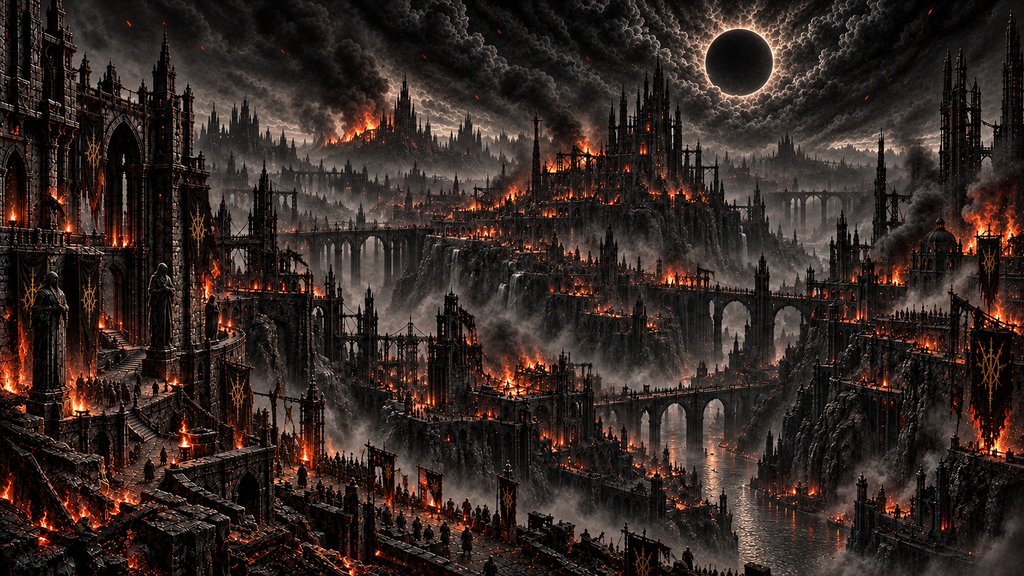
Because Wildcard Campfire is faceless, the music and the world surrounding it have to carry much of the identity. What does remaining anonymous allow you to explore creatively that might be different if the project were centered around individual personalities?
I think the biggest advantage for me is that I don’t have to be the main character of everything I create.
When a music project is built around a particular personality, people often start interpreting everything the artist writes through who that person is in real life. If they write from a certain perspective, listeners might assume that perspective necessarily represents their personal beliefs.
I wanted to give myself the freedom to separate those things more clearly.
I can write about someone who holds power and abuses it, someone who’s been imprisoned, someone struggling with beliefs they grew up with, or even a character who commits terrible acts. I don’t have to identify with a character to find it interesting to understand what drives them and tell their story.
And that doesn’t mean the work isn’t personal. Quite the opposite, actually. A lot of it comes from very personal experiences and emotions. But when I give those experiences to a fictional character, I no longer have to stay completely faithful to what happened in my own life.
I can change the circumstances, push them to extremes, and sometimes even explore the same emotion through a character whose actions I would completely disagree with.
There’s another advantage I really like, too. The project’s visual identity doesn’t have to remain tied to one particular era or character. When the world changes, the aesthetic can change with it, without me feeling like I have to keep presenting the same thing just because that’s what people are used to seeing.
Of course, being faceless doesn’t mean my identity as the creator is a secret. I’m open about being the songwriter and creative force behind Wildcard Campfire, and I’m responsible for the artistic choices I make. I simply don’t want my face to be the center of the project’s identity.
I think that works particularly well for a project where I plan to build different worlds, each exploring different ideas and potentially having its own visual and musical identity.
You describe the music as guitar-written, with each release contributing to a larger story rather than standing completely on its own. How important is it for you to make sure the riffs, melodies and atmosphere serve the story rather than simply existing for their own sake?
It’s very important to me, but it’s equally important that the music is good even if the listener knows absolutely nothing about the story.
I’m a musician first, and I want to write songs that I genuinely enjoy listening to and playing. But once I have a particular story or emotion I want to communicate, it becomes an integral part of the decisions I make while writing.
For example, I might have a riff that I really love, but if it doesn’t fit the atmosphere of the song, I’m not going to force it in just because it sounds good on its own. I’d rather change it or save it for another song.
The same goes for song structure. Some songs need to reach their climax very quickly, while others need time to build atmosphere and tension. Sometimes the right choice is to let an instrumental section develop, and sometimes it’s to strip almost everything away and leave the vocals at the center.
The vocal parts are also heavily influenced by the story. I think not only about the lyrics themselves, but also how they should sound, when to bring in clean singing or harsh vocals, and how the delivery can change the feeling the listener gets.
That said, I don’t think every riff or chord change has to represent a specific event in the story. Sometimes a great riff is just a great riff, and that’s perfectly fine.
To me, the right balance is when the song works on its own, but someone who knows the story can come back to it and discover additional meaning in its structure, melodies, and atmosphere.
I don’t want the story to be an excuse for the music, and I don’t want the music to be nothing more than a soundtrack to the story. I want both of them to benefit from each other.
What have you learned about building a fictional world through music while developing “Where God Grew Tired,” and were there any parts of the album that developed in a completely different direction from what you originally imagined?
One of the main things I’ve learned is that there’s a big difference between building a detailed world and making people feel like that world actually exists.
You can write thousands of years of history, create characters, laws, and kingdoms, but not every single detail needs to end up in a song’s lyrics. Sometimes leaving things in the background and allowing listeners to discover them on their own makes the world feel bigger and more interesting.
As for the overall direction of Where God Grew Tired, I wouldn’t say the central vision changed completely during the process. The main ideas and themes were there from the beginning, but some of the stories definitely developed in ways that gave them a different meaning or a much larger scale than I originally imagined.
A good example is The Tion Revolution. Initially, I imagined the song as a story taking place in a specific region of the world, describing the beginning of resistance within a system of control and oppression.
By the way, there’s also a little writing challenge I gave myself with that song. I structured much of the lyrics so that almost every line begins with a word ending in “-ion,” like Oppression, Depression, Division, or Revolution. I liked the idea of the words themselves creating a repetitive, almost mechanical rhythm while the lyrics describe a system trying to control how people think, speak, and behave.
But as the world developed, I realized that in a civilization so large and chaotic, with different systems of government and oppression across different regions, uprisings like these probably wouldn’t happen in just one place.
So the story expanded. Instead of representing one local revolution, the song began representing a pattern of resistance emerging in different parts of the world. Not necessarily the same revolution or groups working together, but different situations where people reach a point where they’re no longer willing to accept the system controlling their lives.
Another example is The Beast With My Name.
The original idea was to tell the story of a war criminal whose time had finally come to pay for their actions. But as I developed the story, it grew into something much bigger.
In the final version, we meet a character who built an entire kingdom around fear, lies, and hatred, and whose own decisions and actions ultimately brought about its destruction. The song takes place as that kingdom is burning, the character’s power is collapsing, and there’s no longer any way to escape responsibility or the people coming to make them answer for what they’ve done.
What I like about that change is that the story is no longer just about someone who committed terrible crimes and is about to face punishment. It’s also about an entire system built around that person, and how that system eventually becomes the very thing that brings them down.
In both cases, the basic ideas remained similar, but as I understood the world and its history better, the stories took on a much broader meaning.
I think that’s one of the most interesting things about building a world this way. You can start with a fairly focused idea and then discover that it connects to something much bigger than you originally expected.
And one of the things I’ve learned is knowing when to let a story develop and when to stop trying to explain every little detail. Ultimately, I want the world to be rich enough to feel real, but still leave listeners room to imagine and interpret things for themselves.
—
Heavy music has a very passionate community, but your project also places a strong emphasis on narrative and cinematic storytelling. Who do you imagine listening to this album, and what do you hope they take away from the world after spending time with it?
I didn’t really sit down while writing the album and try to imagine one ideal listener I needed to appeal to.
I listen to a lot of different musical styles myself, so it felt natural to create something that could appeal to people who enjoy different kinds of heavy music, but also to those who connect with cinematic music, melodies, and storytelling.
I also don’t expect everyone who listens to the album to enjoy every song equally. With so much variety, I think it’s completely natural for one person to connect more with the melodic and emotional side, while someone else prefers the aggressive or progressive sections.
To me, there’s no single correct way to enjoy Wildcard Campfire.
But if we’re talking about what I’d like people to take away from the world after spending time with it, I think the answer is mainly questions.
Not necessarily answers, and definitely not a message that I expect everyone to agree with.
I’d love for someone to listen to a character’s story and wonder how they themselves would behave in that situation, or for something in the narrative to make them think differently about things we sometimes take for granted in the real world.
On the other hand, not every moment on the album needs to be a philosophical lesson. Sometimes I just want someone to enjoy a good riff, a crushing breakdown, or a chorus that gets stuck in their head.
One of the things that has made me happiest since I started releasing music is discovering how differently people connect with it. Different listeners message me about completely different songs, sometimes with interpretations I hadn’t even considered while writing them.
I think that’s one of the most beautiful things about creating something. Once it’s out there, people start finding something of their own within it.
So if someone enjoys the album and wants to come back to it, I’m already happy. And if, after a few more listens, they discover another layer of the story or find something that makes them think, that’s even better.
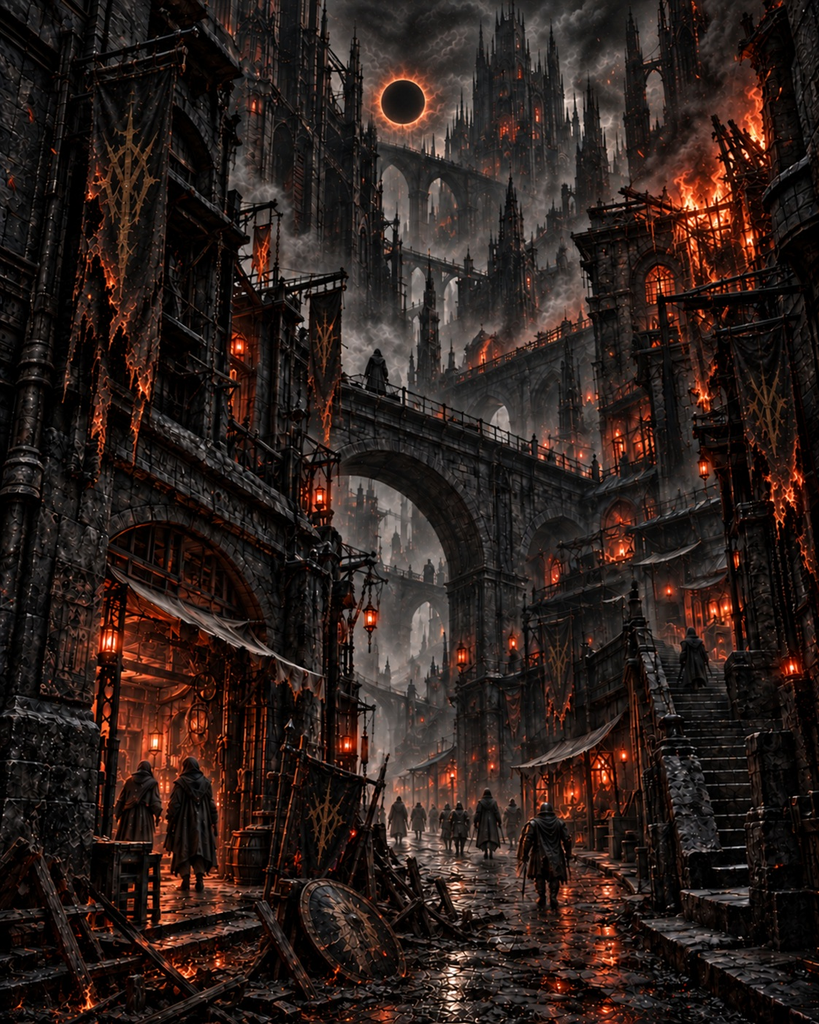
Now that “Where God Grew Tired” is out, what comes next for Wildcard Campfire? Are you already thinking about where the story goes from here, and how far do you want to take this world?
I think it’s important to separate the future of the Where God Grew Tired world from the future of Wildcard Campfire itself.
To me, this era’s story reaches its conclusion with A Hymn for the Unburied. That doesn’t mean there aren’t other places, periods, or stories within that world that could be explored, but I feel that the central idea I wanted to communicate has reached the right point to end.
I actually like the fact that the ending leaves listeners with questions that don’t necessarily have answers. I wouldn’t want to continue the story just to explain exactly what happened to every character or how the civilization developed afterward.
But when it comes to Wildcard Campfire, I definitely don’t see this as the end of anything. Quite the opposite. To me, this is just the beginning.
I’ve already started working on the next world, and this time I want to take things in a very different direction. Instead of a world that begins with a dark fantasy atmosphere and progresses through thousands of years of wars and developing civilizations, I want to start in the near future, within a dystopian setting with a more psychological and clinical atmosphere.
What interests me this time is focusing less on massive historical events and wars between different groups, and more on human psychology, identity, and the ways people experience and interpret the reality around them.
I’m particularly interested in how those interpretations shape our behavior and decisions, and how, over time, they can even change the world we live in. Two people can experience the same event and walk away with completely different versions of what happened. I think there’s a lot of interesting territory to explore there, especially in a world where institutions, technology, and individual psychology might all influence what people believe to be real.
I’m still in the early stages of writing and world-building, so I don’t want to commit to every detail or where the story will eventually go. One of the things I love about creating is allowing ideas to develop as I work on them, rather than feeling like I have to reach a particular ending simply because I planned it in advance.
In the meantime, there are still a few things I want to do with Where God Grew Tired, including the Lore Book and lyric books, a Deluxe Edition with additional material, and some playthroughs I’m working on making happen while trying to maintain the project’s faceless aesthetic.
But for me, there’s no race. I want to give every world and every piece of music the time it needs, rather than releasing things just to maintain a particular schedule.
One of the most important things to me is not turning Wildcard Campfire into a project that keeps repeating the same formula over and over again. I want to keep challenging myself, experimenting with new musical ideas, and building worlds that have something different to say.
If Where God Grew Tired was my way of looking at humanity through its history, power, and beliefs, I want the next world to let me explore humanity from a completely different perspective.
And I think that’s exactly the kind of freedom I wanted when I created Wildcard Campfire in the first place
CONNECT
Facebook | Spotify | Soundcloud | Youtube | Instagram | Tiktok
https://linktr.ee/wildcardcampfire
