






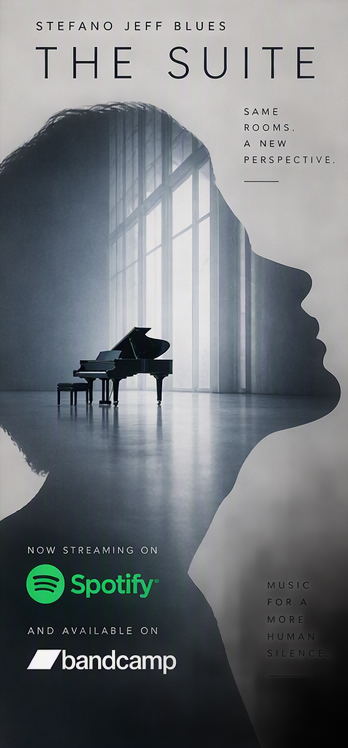
For Stefano Jeff Blues, music has never been simply about playing an instrument or fitting into a particular genre. A pianist, guitarist and composer from Bologna, his musical journey began with an unexpected fascination with the piano and grew through the influence of artists such as Keith Jarrett and Eric Clapton. Eventually, the piano and guitar became two sides of the same musical language, with the blues providing the connection between them.
That relationship with the blues has remained central to his work, but Stefano does not treat it as a formula. For him, the blues is a way of expressing something deeply human with very little, allowing silence, space and emotion to carry as much weight as the notes themselves. Jazz harmony, gospel, blues-rock, R&B and electronic textures have since become part of his broader musical vocabulary, giving him different ways to expand on that foundation.
This approach is especially clear in THE SUITE, an eleven-track project conceived not simply as an album but as a house made up of eleven rooms. The idea began with an image of an empty chair in a room, which became “A Chair in Silence.” From there, Stefano began to see the other compositions as doors along a corridor rather than individual songs waiting to be heard.
Each piece occupies its own emotional space. There is movement without destination, memories rising slowly, flashes of light without conventional melody, warmth behind muffled sounds and, throughout the project, a recurring sense of waiting. Instead of guiding listeners through a fixed narrative, Stefano creates an environment where they can bring their own memories and experiences into the music.
Silence plays an equally important role. For Stefano, it is the space where the notes exist, and knowing when not to play becomes just as important as knowing what to play. That philosophy gives his music an intimacy that does not depend on excess. Every note has to earn its place.
His creative process is equally personal. Projects often begin with an image, concept or feeling before gradually expanding into music, visual elements, stories and written material. Working independently gives Stefano complete creative control over that process, from the first chord through recording and production to the final release. It also allows each album to exist as a complete world rather than simply a collection of tracks.
That desire to create immersive worlds continues beyond THE SUITE. His recent release Unclaimed Fire arrived on October 1, while Riff – The Pentatonic Code is set for release on November 1, exploring the pentatonic scale as a kind of musical DNA connecting the blues, folk traditions and music from different parts of the world.
In an era where music is increasingly consumed in short fragments, Stefano Jeff Blues is interested in something slower. He wants listeners to stay with the music long enough to enter its spaces, discover their own meanings and perhaps leave feeling slightly different from when they arrived.
We caught up with Stefano Jeff Blues to discuss his journey between piano, guitar and the blues, the concept behind THE SUITE, the creative power of silence, working independently, and his continuing search for new musical worlds to explore.
For anyone discovering Stefano Jeff Blues for the first time, can you take us back to how you got into music and tell us about the experiences that shaped you into the artist you are today?
I’m a pianist, guitarist and composer from Bologna. I came to the piano almost by accident, when I was about eight, and I remember the evening I really fell in love with it: I was listening to Keith Jarrett’s The Köln Concert. Later, La Scala confirmed that fascination with the piano, while Eric Clapton’s Unplugged opened another door for me, the guitar.
The blues arrived almost straight away, somewhere between those two instruments. I found that the piano had something the guitar didn’t, and the guitar gave me something the piano couldn’t. Bringing them together became my way of finding my own musical language.
That’s probably why I’ve never seen the blues as just a genre. For me it’s a way of saying something heavy with very few notes, and everything I’ve done since has grown from there.

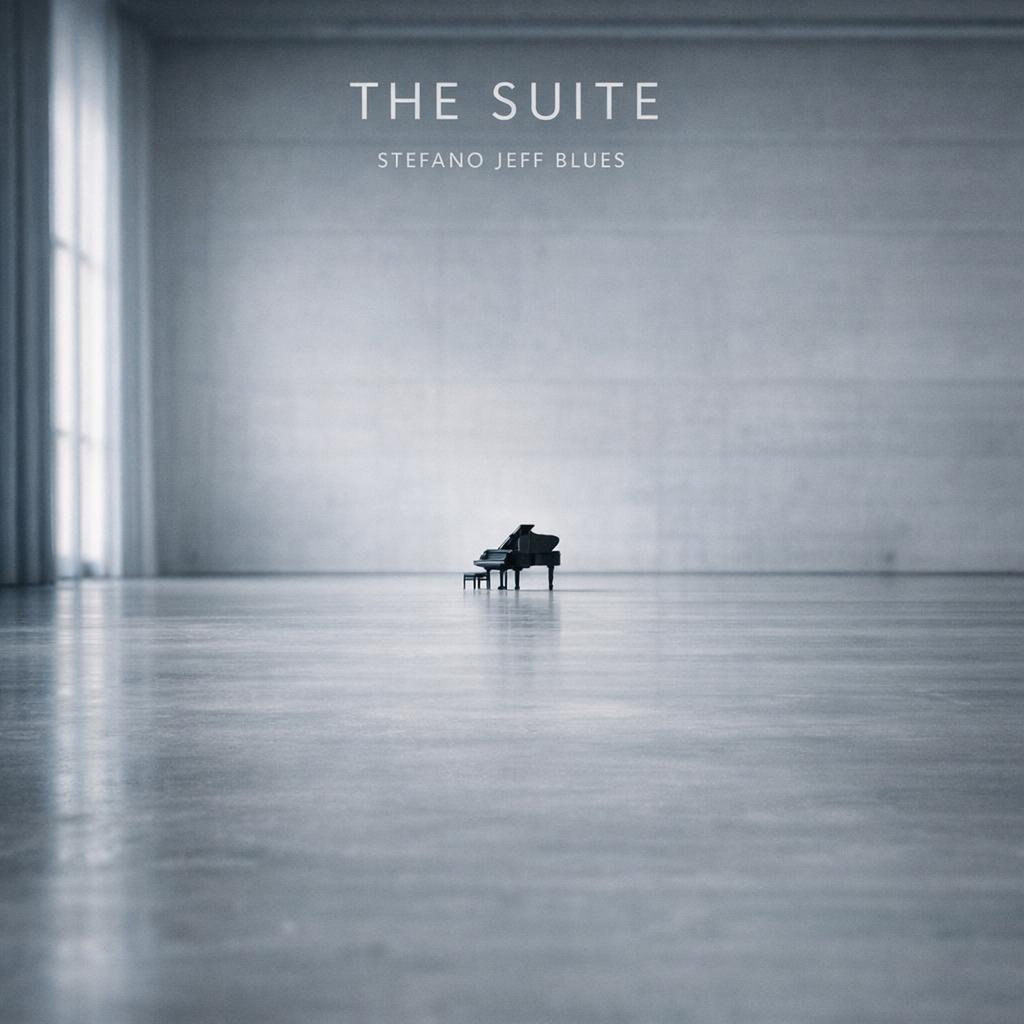
The idea behind THE SUITE is that the eleven tracks are eleven rooms. Where did this concept come from, and when did you realise the album needed to be experienced as a complete space?
It started with an image: an empty chair in the middle of a room, with no one coming in and no one leaving. That became A Chair in Silence, and I realised the other pieces weren’t songs waiting in line. They were doors along a corridor.
From that moment I stopped thinking in tracks and started thinking in spaces. There’s no story told from beginning to end, more a place you live in for a while: eleven rooms, a single breath. If you listen to one piece on its own you see a room; if you listen from start to finish, you walk through the whole house.
Piano, silence, memory, waiting and atmosphere all play important roles. How did you use these elements to create the feeling of moving through different spaces and emotional states?
Each room has its own air. In the Corridors the piano keeps walking, so you feel movement without a destination. In Dust in the Air memories rise slowly, like dust in still light. Interlude: Static Light has almost no melody, only flashes, because some places are made more of light than of sound.
In Soft Walls everything is muffled and warm. Waiting is the thread that ties them all together: many of the pieces seem to be listening for something that hasn’t arrived yet.
You describe blues as a starting point rather than a destination. What continues to draw you to the blues, and how do jazz harmony, gospel, blues-rock, R&B and electronic textures help you take that foundation somewhere new?
The blues is honest. It doesn’t decorate pain, it sits with it, and that’s why I keep coming back to it. But I don’t want to play it like a museum piece.
Jazz harmony gives me colours the blues alone wouldn’t have, gospel brings light and a sense of community, blues-rock brings the body, and electronic textures let me build spaces around the notes. In The Suite the blues is mostly underground: you may not hear a twelve-bar form, but you can feel where it comes from.
Silence appears to be as important as the instruments. What have you discovered about the expressive power of leaving space, and how do you know when a song needs another note versus silence?
For me silence is the room the notes live in. I’ve learned that a pause can say more than a phrase, because it gives the listener time to answer.
My rule is simple: if a note only fills space, it goes. If taking it away makes the music lose its breath, it stays. With solo piano you can’t hide behind an arrangement, so every note has to earn its place.
When you begin a new project, do you start with a musical idea, an image, a story or a feeling, and how does that grow into a complete world?
Almost always with an image or a concept. For The Suite it was a room; for my next album, Riff – The Pentatonic Code, out on 1 November, it’s the idea of a musical DNA hidden in the pentatonic scale.
Then the music, the cover, the booklet and the stories grow together. Every album comes with a booklet in five languages, with a short text for each track, because I want the listener to step into a world and not just press play.

You run your projects independently. How important is creative control, and what are the challenges of carrying so many parts of the process yourself?
Being independent means having complete creative control, but it also means following an idea all the way from the first instinct to the finished record. My pieces often begin with something that happened to me, a memory, an image or a story. I sit down at the piano or pick up the guitar and start looking for a sequence of chords that captures that feeling.
I record the first ideas in Logic Pro and then slowly build around them: a bass line, drums, different layers, until I have a space where I can improvise on piano or guitar. From there it becomes almost like editing a film. I cut, move things around, add something, take something away, and keep going until the piece feels complete.
Then comes another part that matters just as much to me: I write the story behind each track and connect the music to the visual and narrative world of the album. Being independent lets me follow that whole journey, from the first chord to the release. The hard part is that you’re also your own label, art director and promoter. It takes a lot of time and everything is self-funded, but the freedom is worth it.
THE SUITE leaves plenty of room for interpretation. How important is it to leave emotions, images or meanings open so listeners can bring their own experiences?
It’s essential. The titles and the booklet texts are only doors: I tell you there’s a chair, a corridor, dust in the air, but I don’t tell you who sat there or what the dust remembers.
Everyone fills those rooms with their own memories. When someone tells me a track made them think of their grandmother’s house, or a hospital corridor, that’s when I feel the album is really finished.
In today’s music environment, what does authentic music mean to you, and what do you hope happens when someone gives THE SUITE the time to listen from beginning to end?
Today we’re surrounded by content made to be consumed in fifteen seconds. For me, authentic music asks for a bit of time and gives something back.
I hope that someone who listens to The Suite from the first room to the last comes out a little slower than they went in, maybe a little more aware of the silences in their own day. If thirty-five minutes of piano can do that, it’s worth it.


Now that THE SUITE has opened this door, what are you curious to explore next, and will future projects keep building immersive musical worlds?
Yes, every album is a world of its own. My new album Unclaimed Fire came out on 1 October, and Riff – The Pentatonic Code follows on 1 November. It explores the pentatonic scale as a kind of musical DNA shared by the blues, folk and music from all over the world.
I’m curious about the places where the blues meets other cultures and other times. The rooms will change, but the door will always be open. You can find everything at www.stefanojeffblues.com.
CONNECT


