


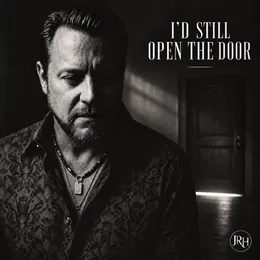
What happens when the person you spent so long trying to forget suddenly becomes the person you would still welcome back? That emotional contradiction sits at the centre of “I’d Still Open the Door,” the compelling new song from independent songwriter and vocalist JRH. Rooted in Southern country soul, Americana and rock, the track explores the lasting impact of a relationship through intimate storytelling, evocative imagery and an arrangement that allows every emotion to unfold naturally.
Rather than telling a conventional story of heartbreak, JRH approaches the subject from the perspective of someone who has come to understand why a relationship ended but has never entirely made peace with losing the person. It is a delicate distinction that gives the song much of its emotional power. There is no attempt to rewrite the past or pretend that everything was perfect. Instead, the narrator acknowledges the difficulties, remembers the beautiful moments and confronts an uncomfortable truth: knowing how things ended does not necessarily mean the heart would make a different choice.
The song begins with a simple image of headlights sweeping across a bedroom ceiling in the early hours of the morning. It is a moment of uncertainty that quickly becomes a journey into the past. From the first encounter in a crowded room to the excitement of falling for someone despite the warning signs, JRH constructs a relationship through carefully selected details that make the story feel lived-in and authentic.
One of the most affecting aspects of the writing is the attention given to everyday intimacy. The narrator does not ask for grand gestures or an idealised romance. Instead, the memories that matter most are the ordinary experiences that become precious in retrospect: sharing mornings, seeing familiar shoes beside the door and simply having someone there. These details give the song a sense of realism, reminding listeners that the smallest moments can sometimes leave the deepest emotional marks.
As the story progresses, the relationship’s difficulties become harder to ignore. The other person admits they cannot provide what the narrator wants, and eventually the separation becomes unavoidable. JRH handles this turning point with understated emotion, describing a departure without turning it into an argument or a dramatic confrontation. The image of standing in the driveway as the taillights disappear captures the loneliness of an ending that cannot be negotiated.
But the emotional journey does not stop with the departure. Time passes, seasons change and the narrator gradually learns to navigate life alone. Yet the absence of someone is not always measured by how often they are remembered. Sometimes it is revealed in the quiet spaces they once occupied and in the memories that unexpectedly return. JRH captures this tension through the recurring admission that, despite everything, the door would still be open.
Musically, “I’d Still Open the Door” draws on the expressive qualities of a slow 6/8 country-soul ballad. Its gentle rhythmic movement provides a fitting foundation for the song’s reflective character. JRH begins with a close, restrained vocal delivery, giving the opening lyrics an almost conversational intimacy. As the story develops, the instrumentation gradually expands, following the emotional rise and fall of the narrative. This carefully paced progression allows the track to build without losing the personal quality that makes its opening so engaging.
The closing moments provide the song’s defining emotional statement. There is no sudden revelation that everything has been resolved, nor an attempt to present longing as a sign of weakness or strength. Instead, JRH leaves listeners with an honest confession from someone who understands the consequences but cannot deny what they still feel. It is this refusal to disguise the truth that makes the final declaration so affecting.
With “I’d Still Open the Door,” JRH offers a thoughtful exploration of attachment, memory and the complicated nature of moving forward. The song speaks to anyone who has experienced a relationship that ended without necessarily ending the feelings behind it. Through vivid storytelling, heartfelt vocals and a warm country-soul sound, JRH turns a deeply personal reflection into an experience listeners can recognise as their own.
Ultimately, the song asks a question that has no easy answer: if the past came knocking again, would you have the strength to keep the door closed? JRH’s answer is unmistakable.
