






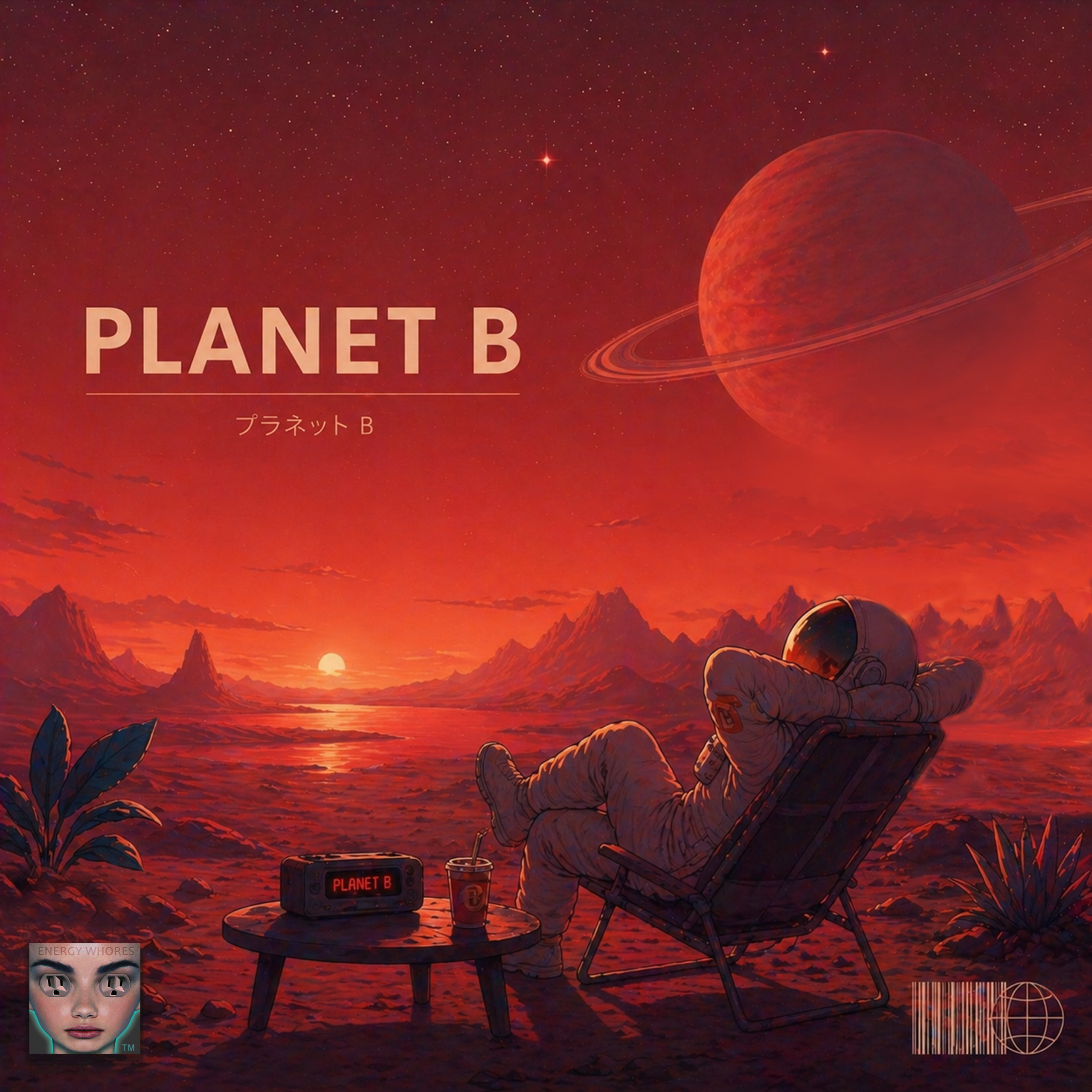
Planet B is the kind of song that feels like it arrives with a purpose. It does not just play, it confronts. From the very first line, it pulls the listener into a strange and vivid space where technology, space, and human emotion overlap in unexpected ways. The writing is bold, imaginative, and deeply intentional, creating a world that feels both futuristic and uncomfortably familiar.
One of the most impressive aspects of the song is its originality of imagery. The opening line, “a toothy terabyte took a bite in the side of time,” immediately sets a creative tone that is hard to ignore. It takes digital language and turns it into something almost alive, almost dangerous. Time itself is no longer safe or stable; it feels like something that can be damaged or consumed. That single idea captures the emotional core of the track, which is that the systems we rely on, whether environmental or technological, are not as permanent as we assume.
The song continues this blend of cosmic and digital imagery with striking consistency. Lines like “star lights… bent by gravities eyes” and “I lay in the snow, white crystals blow against the black sky” create a wide, cinematic atmosphere. There is a strong sense of isolation here, but also beauty. The universe feels vast and silent, yet emotionally charged. It mirrors the feeling of standing in a world that is both incredibly advanced and deeply fragile at the same time.
What makes “Planet B” especially powerful is how it balances abstraction with clarity. The lyrics move through surreal, almost dreamlike images, but they always return to a simple, unavoidable truth: “there is no Planet B.” This repetition is one of the strongest elements of the song. It is not complicated or poetic in a traditional sense, but its simplicity is exactly what gives it weight. Each repetition feels more final, more grounded, like a reminder that cannot be escaped or ignored.
The technological imagery in the middle of the song adds another layer of meaning. The line “an angry motherboard took my data and threw it out” is particularly effective because it reflects modern dependence on digital systems while also showing their instability. Even the “cloud,” often seen as a symbol of safety and storage, is described as being “all rained out,” turning something familiar into something unreliable. This subtle shift reinforces a larger idea in the song: even the systems we trust to protect us are not immune to breakdown.
Emotionally, the track carries a steady sense of urgency without ever becoming chaotic. It does not rely on intensity alone. Instead, it builds tension through atmosphere, repetition, and carefully chosen imagery. This gives the song a reflective quality. It invites the listener to think rather than simply react, which makes its message linger long after it ends.
There is also a strong cinematic quality running throughout the lyrics. Even without focusing on production, the writing suggests movement, scale, and visual depth. It feels like a sequence unfolding across space and time, where digital noise and cosmic silence coexist. That sense of scale gives the song a weight that goes beyond its words.
At its heart, “Planet B” is a reflection on denial and consequence. It challenges the comforting idea that humanity can always escape its problems by moving elsewhere or relying on future solutions. Instead, it keeps returning to one simple truth: this is the only place we have.
What makes the song stand out is how it communicates that message without forcing it. It does not preach, and it does not overwhelm. It simply presents its vision and allows the listener to sit with it. That restraint is part of its strength.
Overall, “Planet B” is a beautifully constructed, thought-provoking piece of modern electronic storytelling. It is imaginative without being confusing, emotional without being excessive, and meaningful without being heavy-handed. It is the kind of song that leaves an impression not because it demands attention, but because it earns it through creativity, clarity, and emotional depth.


