


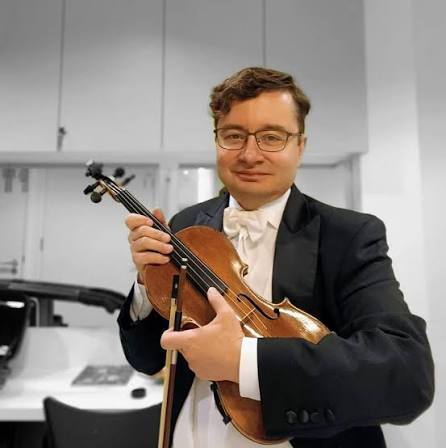
For Sergiy Bolotny, the violin is more than an instrument. It is a way of carrying memory, culture and emotion from one place to another. Born in Ukraine and now based in the Netherlands, the concert violinist and composer has built a career across orchestral performance, composition and solo work, while continuing to explore the musical traditions that shaped him.
His latest release, “Ukrainian Caprice No. 4: Sycamore & Burlesque,” brings that connection to heritage into sharp focus. Inspired in part by the poetry of Taras Shevchenko and traditional Ukrainian dance, the piece moves between two strikingly different emotional worlds. “Sycamore” begins with introspection and melancholy before giving way to the spirited energy of “Burlesque.” For Bolotny, that contrast is not simply a compositional decision. It reflects something he recognises in Ukrainian character itself, a tendency toward deep reflection followed by resilience, humour, energy and a determination to keep moving.
Interestingly, the two sections were originally separate compositions. Bolotny decided to bring them together shortly before recording, believing that the listener needed that moment of melancholy before entering the celebration. It is a small detail that says a lot about his approach to composition. He is not afraid to revisit his own work, question it and reshape it until the emotional journey feels right.
Throughout his Ukrainian Caprices, Bolotny works with folk melodies without treating them as untouchable historical artefacts. He keeps their emotional identity recognisable while surrounding them with demanding contemporary violin techniques, creating music that respects its origins without becoming trapped in the past. His approach has also been recognised within Ukrainian musicological scholarship as part of the neo folkloric tradition associated with composers such as Myroslav Skoryk.
His relationship with the violin is equally grounded in decades of performance. Paganini has been a particularly important influence, not only for the technical possibilities of the instrument but for the energy Bolotny finds within the music. When composing difficult passages, he tests his ideas through performance, asking whether they are genuinely effective on the instrument or simply complicated for the sake of complexity.
That practical relationship between composition and performance is central to his work. So is his belief in acoustic honesty. Rather than relying heavily on studio production, Bolotny prefers allowing the violin to breathe naturally, preserving the resonance and subtle dynamics that he hears when he imagines the music.
Educated in Lviv, Kyiv and Vienna and now serving as Assistant Second Concertmaster with the Noord Nederlands Orkest, Bolotny has experienced several musical traditions and schools of thought. Yet he believes they ultimately lead toward the same goal: musical beauty that feels natural rather than forced.
In this conversation with Spinex Music, Sergiy Bolotny discusses the making of “Ukrainian Caprice No. 4,” the emotional character of Ukrainian music, his relationship with Paganini, the responsibility of bringing folklore into contemporary classical music, and why his next creative horizon may take him far beyond Europe, toward Japan.
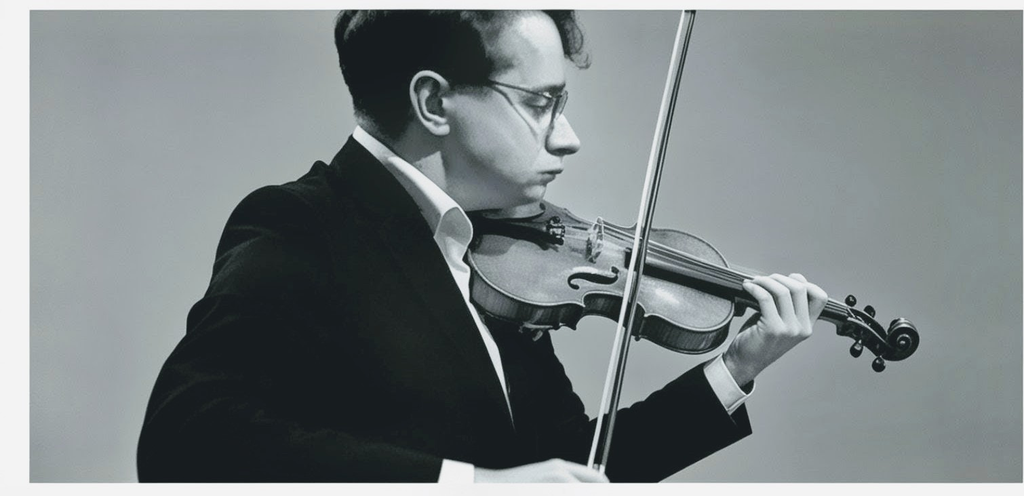
. “Ukrainian Caprice No. 4: Sycamore & Burlesque” brings together the melancholy of Taras Shevchenko’s poetry and the energy of traditional Ukrainian festive dances. What drew you to these two contrasting sources, and when did you realise they belonged within the same musical work?
A very important question! Prior to this release, Sycamore and Burlesque actually existed as separate pieces. Like many composers, I am rarely completely satisfied with my work—even now, after the release, I find myself wanting to refine things further! Just before recording, I felt that Burlesque was perhaps a bit too short on its own. In Ukraine, many listeners loved the original standalone version (which is still available on SheetMusicPlus), while Sycamore had quietly drifted into the background after some initial interest on Facebook.
Musically, Sycamore is set in F minor and Burlesque in F major. I reworked the transition at the end of Sycamore and joined the two pieces together. I simply felt the listener needed a touch of introspective melancholy before diving headfirst into the celebration!
The opening “Sycamore” movement has an intimate, cantabile character rooted in Slavic lyricism, while “Burlesque” suddenly shifts into fiery virtuosity and playful rhythmic movement. What does that emotional contrast represent to you, and how important was the idea of transformation to the structure of the piece?
By nature, many Ukrainians are sensitive and contemplative. This isn’t solely a reaction to current events or the war; it is woven into our cultural DNA. Yet, that melancholy rarely lingers for long—it gives way quickly to resilience, energy, and optimism. That emotional arc represents our spirit: we reflect deeply, but ultimately we choose life, humor, and movement.
Shevchenko’s “Teche voda z-pid yavora” carries strong emotional and cultural associations within Ukrainian heritage. How did you approach translating the spirit of that poetry into an instrumental piece without the words themselves being present?
The opening measures of the piece answer that directly. Instead of presenting the folk melody in a predictable flow, I place a fermata at the end of each four-bar phrase. It acts like an open question: Why is the Cossack sorrowful? Without words, the violin uses silence and lingering resonance to evoke that unspoken yearning.
Your Ukrainian Caprices connect traditional folk material with demanding solo violin writing. How do you decide which elements of Ukrainian musical heritage should remain recognisable and which can be transformed into something more contemporary?
I view variation not merely as a formal textbook device, but as an organic compositional method to develop the primary theme. Interestingly, in a recent musicological study on the evolution of 21st-century Ukrainian solo violin caprices published by the National Music Academy of Ukraine, my cycle was highlighted as continuing the neo-folkloric lineage established by Myroslav Skoryk. The paper analyzed how I combine authentic folklore intonations with progressive violin technique.
In practice, I keep the emotional contour of the folk melody recognizable, but weave in entirely new thematic material as a bridge—almost like an intricate Rondo. Within each caprice, the technical demands evolve progressively, layering double stops, wide-register leaps, and modern spiccato patterns over the folk material. It is about transforming an ancient song into a self-contained, concert-level virtuosic statement without stripping away its soul.
The “Burlesque” section demands rapid spiccato, string crossings and considerable technical control. When composing for your own instrument, how do you balance the physical possibilities of the violin with the musical expression you want the listener to experience?
I have immersed myself in the music of Niccolò Paganini for decades. His works keep my technique sharp, but I also perceive a almost metaphysical energy in his writing—it fuels my creative process directly. When writing demanding passages like those in Caprice No. 4, I constantly record myself playing the sketches to evaluate what is genuinely ergonomic on the fingerboard versus what is unnecessarily awkward. I even share short excerpts on YouTube Shorts to observe how audiences react to specific colors and rhythmic pulses before finalizing a score.
You chose to record the piece with natural room presence and authentic acoustic resonance. What was important to you about preserving the natural character of the violin, and how does that approach compare with the highly produced sound often found in contemporary recordings?
It comes down to artistic intuition. Over recent years, my compositional output has expanded, and I carry an exact acoustic ideal in my mind for how my violin should speak. My music undergoes continuous subtle evolution, and translating that nuanced dynamic range is very difficult with a detached, commercial production style. I prefer acoustic transparency over studio artificiality—the instrument needs room to breathe naturally.
You were educated in Lviv, Kyiv and Vienna before building your career in the Netherlands with the Noord Nederlands Orkest. How have these different musical environments shaped your understanding of tradition, interpretation and your own identity as a Ukrainian musician?
Much like the great traveling violinists of the late 19th and early 20th centuries—such as Kreisler, Enescu, or Flesch—I drew wisdom from diverse regional traditions and pedagogical systems. Yet, over time, I realized that at the highest level, there is fundamentally only one true violin school: the pursuit of pure, unforced musical beauty. From Tokyo to New York, and from Suzuki to Galamian, every dedicated violinist strives toward that same universal truth of expression.
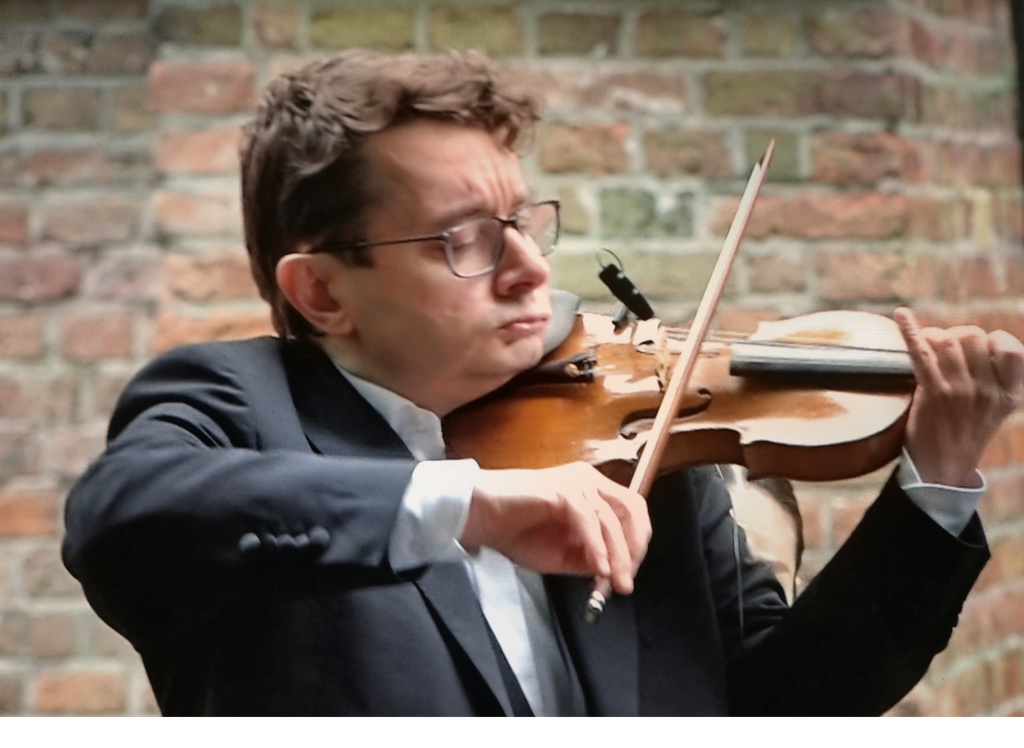
As both a concert violinist and composer, how does performing the music of other composers influence the way you write your own works? Do you find that years of interpreting established repertoire have changed the way you hear your own compositions?
Immersing myself in Paganini’s caprices opened up distinct physical and acoustic pathways for my own writing. For the lively spirit of Burlesque, I also drew inspiration from the rhythmic verve and orchestral colors of Dvořák, Tchaikovsky, and the foundational Ukrainian composer Mykola Lysenko. Decades of analyzing and performing masterworks on stage provide the bedrock upon which all my compositional choices rest.
Your Ukrainian Caprices and Little Dutch Rhapsodies explore different European folk traditions through solo string virtuosity. What interests you about bringing historical cultural material into a modern concert setting, and what do you hope audiences discover through that meeting of past and present?
With the Ukrainian Caprices, that lineage feels natural because Ukrainian classical music has an unbroken tradition of drawing from folklore. Musicologists have described this work as an intentional marking of national identity through the violin—whether referencing Shevchenko’s poetry, classic folk melodies, or paying homage to Skoryk.
When I turned to Dutch themes—such as in my Little Dutch Rhapsody No. 3 (“Capriccio Amsterdam”)—I approached it through a neo-romantic lens, channeling the Kreislerian Old-Viennese tonal tradition. For me as an artist who has made the Netherlands my home for many years, it is a musical dialogue. Folklore should not remain a museum artifact preserved under glass; it belongs on the modern concert stage, meeting audiences where classical technique and lived cultural memory intersect.
Beyond “Ukrainian Caprice No. 4,” what musical or cultural territory are you most interested in exploring next, and is there a particular part of Ukrainian heritage that you feel still deserves a new voice through your violin and compositions?
My next musical horizon is Japan! Japanese traditional aesthetics and cultural discipline fascinate me, and I am eager to immerse myself in that world. Whether a new project achieves widespread commercial success or not is secondary—the artist’s duty is to venture into uncharted territory and simply try. That is my Philosophy
STAY IN TOUCH:
INSTAGRAM | SPOTIFY | TIKTOK | WEBSITE | YOUTUBE | FACEBOOK
