






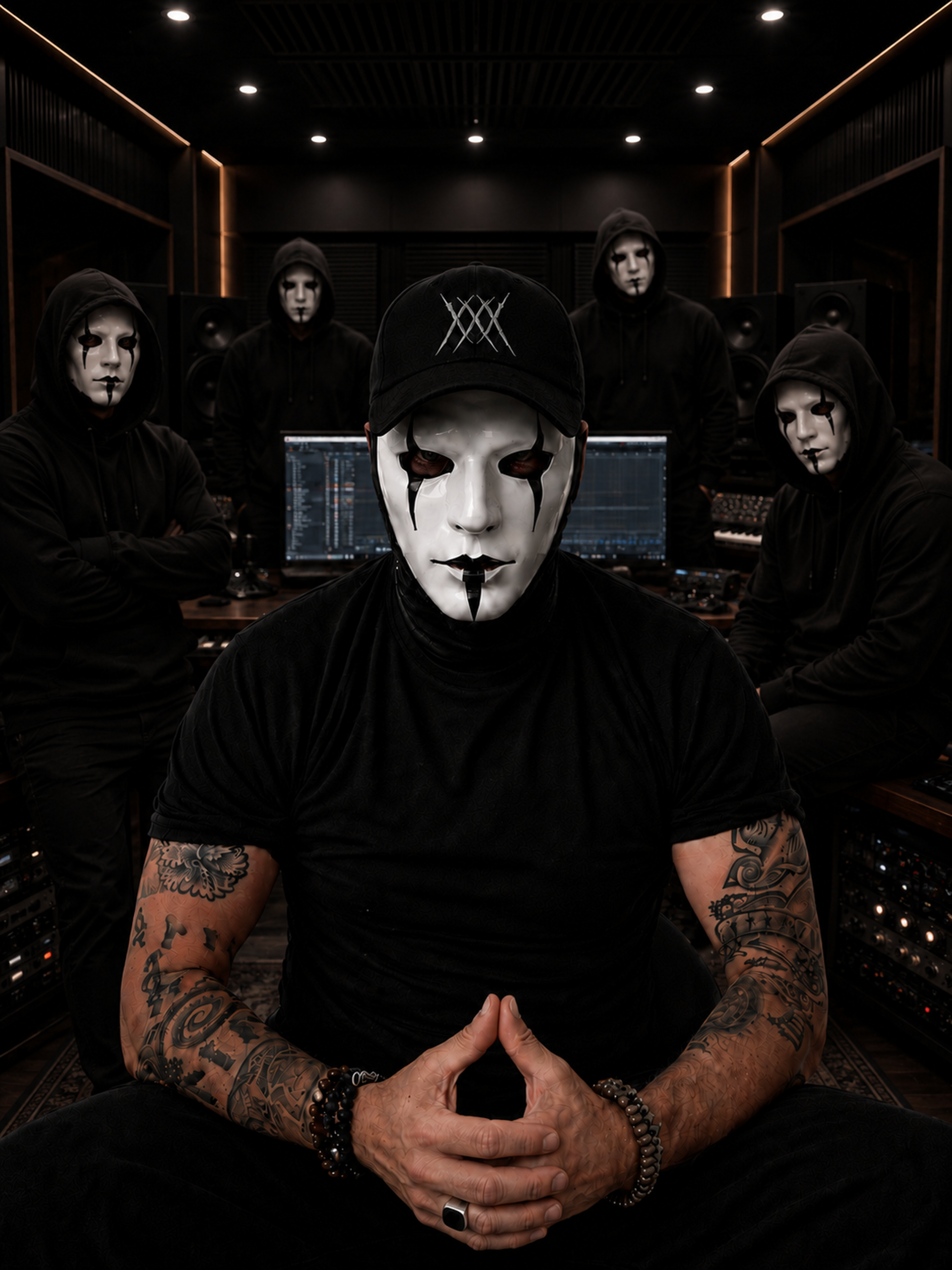
X-ANONYMOUS are experienced musicians with extensive backgrounds in songwriting, shaped by years of creative exploration and a deep understanding of music as both an emotional and intellectual language. Their work is driven by a clear artistic vision that blends intensity, atmosphere, and storytelling, resulting in a sound that is as thought-provoking as it is powerful.
Built on themes of identity, consciousness, and human behavior, the project reflects a unique approach to modern heavy music, where aggression and emotion are carefully balanced with cinematic depth and conceptual meaning. Rather than focusing on surface-level expression, X-ANONYMOUS use their music to explore the unseen forces that shape who we are and how we perceive the world around us.
In this interview, the group opens up about their journey, the ideas behind their latest track “CLAIM IT ALL,” the significance of anonymity in their artistic identity, and the psychological and philosophical influences that continue to shape their evolving sound.


To begin, for readers discovering X-ANONYMOUS for the first time, can you introduce yourself and share what inspired your journey into music and what ultimately pushed you to start a career built around it?
X-ANONYMOUS was born from a lifelong relationship with creativity and expression. I come from an upbringing where music was never treated as background noise; it was a language, a way of processing life, emotion, struggle, and connection. From early on, I understood music as something deeper than entertainment. It was a space where people could meet without prejudice, without hierarchy, and without the barriers that so often divide us.
What inspired me most was the idea that music can reach places ordinary conversation cannot. It can speak across culture, religion, and personal history. It allows people who may never fully understand each other’s circumstances to still feel something together. That, to me, is one of the purest forms of human connection.
Starting X-ANONYMOUS came from the desire to build a creative identity around that belief. I wanted to create music that was emotionally intense, honest, and conceptually driven music that could confront darkness, question the systems around us, and still offer a sense of unity and release. Ultimately, I chose to pursue music seriously because it felt like the most authentic way to communicate what I see, feel, and believe about the world.
Your latest track, “CLAIM IT ALL,” explores themes of identity, control, resistance, and self-reclamation. What was the original idea or experience that inspired the song?
The original inspiration behind CLAIM IT ALL came from observing how easily identity can be shaped, manipulated, or even stolen, whether by other people, societal expectations, technology, or our own internal struggles. I wanted to explore that moment when you realize you’ve been living according to narratives that were never truly yours.
The song isn’t based on a single event; it’s a reflection of a broader psychological and emotional experience. Many people reach a point where they feel disconnected from who they really are because they’ve spent years adapting to survive, fit in, or meet the expectations of others. CLAIM IT ALL is about confronting that realization and deciding to take ownership of yourself again.
The recurring imagery of infection, cages, and control represents those external influences that gradually infiltrate our thoughts and identity. As the song progresses, the protagonist stops accepting those influences and begins reclaiming their autonomy. That’s why the final declaration – “You forged the cage, now watch it fall / Every second, I reclaim it all” is so important. It’s the moment of resistance, liberation, and self-definition.
At its core, CLAIM IT ALL is about breaking free from anything that tries to define you without your consent and finding the strength to reclaim your own existence.
“CLAIM IT ALL,” follows a journey from psychological confinement to personal freedom. What does that transformation represent to you, and why was it important to tell that story through music?
To me, the transformation in CLAIM IT ALL represents the moment an individual becomes conscious of the forces that have been shaping their identity and decides to reclaim ownership of their own existence. Psychological confinement doesn’t always come in obvious forms. Sometimes it’s external pressure, social expectations, manipulation, fear, or even the narratives we unknowingly adopt about ourselves. Over time, those influences can become so deeply embedded that they begin to feel like part of who we are.
Part of my perspective on these themes comes from both my academic and professional interests. I graduated in Psychology years ago, and I have also been involved in neuroscience for many years. Those fields gave me a deep appreciation for the complexity of human behavior, identity, perception, and the countless influences that shape how we think about ourselves and the world around us. While CLAIM IT ALL is ultimately an artistic expression rather than an academic one, many of its themes are rooted in questions that have fascinated me for a long time: How much of our identity is truly our own? How are our beliefs formed? And what happens when we begin to challenge the narratives we’ve inherited or internalized?
The song explores the process of recognizing those invisible constraints and confronting them. The imagery of infection, cages, and control reflects how destructive influences can infiltrate our thoughts and gradually disconnect us from our authentic selves. The journey toward freedom begins when that conditioning is exposed and challenged.
It was important for me to tell that story through music because music has a unique ability to communicate emotional and psychological experiences in a way that words alone often cannot. Heavy music, in particular, allows you to embody conflict, tension, resistance, and ultimately liberation. The intensity of the sound mirrors the intensity of the internal struggle.
At its core, CLAIM IT ALL is not just about rebellion against external forces; it’s about self-discovery. It’s about reaching a point where you stop allowing others to define your worth, your identity, or your future. The final act of reclaiming everything is a declaration of personal sovereignty, a refusal to remain trapped by fear, manipulation, or imposed identities. I believe that’s a deeply human journey, and one that resonates regardless of culture, background, or circumstance.
Anonymity remains a key part of X-ANONYMOUS’ artistic vision. In an era where personal branding often drives success, why do you believe anonymity still matters?
In many ways, anonymity is more relevant today than ever. We live in a culture where visibility has become a form of currency. Personal branding, constant self-promotion, and the cultivation of online identities often take center stage, sometimes even overshadowing the art itself. I wanted X-ANONYMOUS to move in the opposite direction.
The decision to remain anonymous is not about secrecy; it’s about focus. By removing personalities from the foreground, we invite listeners to engage directly with the music, the ideas, and the emotions rather than becoming attached to the individuals behind them. The goal is for the work to stand on its own merits and create a space where people can project their own experiences and interpretations onto the songs.
My background in Psychology, and my involvement in neuroscience over many years, has also influenced this perspective. Both fields have taught me how strongly human perception is shaped by labels, identities, status, and preconceived notions. The moment we know who someone is, we begin constructing narratives around them. We form expectations, biases, and assumptions that can alter how we receive their message. Anonymity challenges that process. It asks a simple question: What remains when you remove the face, the biography, and the social identity?
That question sits at the heart of X-ANONYMOUS and much of the MASKED EXISTENCE concept. Many of our songs explore identity, perception, and the masks people wear, both voluntarily and involuntarily. Remaining anonymous is not just a visual choice; it’s an extension of those themes. It allows the project itself to become a reflection on how we define ourselves and how we define others.
Ultimately, I believe music is at its most powerful when it creates genuine human connection. If anonymity helps shift the focus from the artist’s persona to the shared experience of the music, then it serves a meaningful purpose. In a world increasingly obsessed with who is speaking, sometimes it’s important to focus on what is being said.
Your music combines heavy metalcore elements with industrial textures and cinematic atmospheres. How do you approach blending aggression, emotion, and storytelling into a cohesive sound?
For me, the songwriting process always begins with the story. The music is there to serve the narrative. Whether the theme is identity, psychological conflict, technology, resistance, or personal transformation, I want every element, from the riffs and rhythms to the atmospheres and production choices, to reinforce the story being told.
The heavier metalcore elements provide the raw energy and intensity. Aggression is a powerful tool because it can express frustration, struggle, defiance, and confrontation in a very direct way. But aggression on its own isn’t enough. Without contrast, it loses its impact. That’s where the cinematic and industrial elements come into play. They help create mood, tension, and a sense of environment, allowing the listener to feel immersed in the world of the song rather than simply hearing it.
I’ve always been fascinated by the psychological and emotional dimensions of music. Human emotions are rarely one-dimensional; fear can coexist with hope, anger with vulnerability, and despair with determination. I try to reflect that complexity in the music by balancing crushing heaviness with moments of atmosphere, melody, and reflection.
The industrial textures also serve an important conceptual role. Many X-ANONYMOUS songs explore themes related to technology, control, perception, and the systems that influence human behavior. The mechanical and synthetic elements help sonically represent those ideas, while the more organic musical moments represent the human experience at the center of the story.


Ultimately, I want each song to feel like a journey. The listener should not only hear the conflict, but experience it. The aggression provides the force, the emotion provides the connection, and the cinematic storytelling provides the context. When those elements work together, the music becomes more than a collection of sounds, it becomes a narrative experience that invites the listener into the world behind the song.
Many of your songs explore complex topics such as consciousness, identity, memory, and human behavior. How has your background and interest in neuroscience influenced your songwriting and creative process?
Psychology and Neuroscience has had a profound influence on both my songwriting and the broader creative vision behind X-ANONYMOUS. While music and science may appear to exist in very different worlds, I’ve always seen them as complementary ways of exploring the same fundamental questions about what it means to be human.
Having graduated in Psychology years ago and remained actively involved in neuroscience for many years, I’ve spent a great deal of time studying how perception, memory, consciousness, identity, and behavior emerge from the complex interaction between the brain, the body, and the environment. The more you learn about the mind, the more you realize that many of the things we take for granted, our beliefs, memories, emotions, and even our sense of self, are far more dynamic and fragile than they appear.
Those ideas naturally find their way into the music. Many X-ANONYMOUS songs explore the tension between objective reality and subjective experience, the influence of external systems on individual thought, and the question of how much control we truly have over our own identities. Themes such as manipulation, conformity, self-awareness, and personal transformation are recurring because they reflect questions that neuroscience and psychology continue to investigate.
At the same time, I’m not interested in turning songs into scientific lectures. The goal is not to explain neuroscience through music, but to use scientific insights as a source of inspiration for storytelling and artistic exploration. Science provides the questions, while music explores the emotional experience of living with those questions.
I find it fascinating that neuroscience can describe many of the mechanisms behind human behavior, yet it still leaves room for mystery, meaning, creativity, and personal interpretation. That intersection between what we understand and what remains unknown is often where the most compelling art emerges.
Ultimately, X-ANONYMOUS is about exploring the hidden dimensions of human existence. Neuroscience has given me a framework for examining those dimensions, while music allows me to express them in a way that is emotional, immersive, and deeply personal. Together, they create a space where scientific curiosity and artistic expression can coexist and enrich one another.
Looking at your journey so far, what has been the most important lesson you’ve learned as artists about staying true to a creative vision in a highly commercial industry?
One of the most important lessons I’ve learned is that authenticity has a longer lifespan than trends. The music industry, like many creative industries, is constantly evolving. Styles change, platforms change, algorithms change, and there is often pressure to adapt to whatever is generating attention at a particular moment. While there’s nothing wrong with growth or evolution, I’ve learned that chasing trends rarely leads to meaningful or lasting art.
From the beginning, X-ANONYMOUS was built around a clear creative philosophy: explore the deeper dimensions of human existence through music that combines emotional intensity, intellectual curiosity, and honest storytelling. That vision has sometimes meant taking a less conventional path, but it has also provided a compass whenever difficult decisions arise. When you have a strong sense of purpose, it becomes easier to distinguish between opportunities that support your vision and distractions that pull you away from it.
As artists, it’s easy to become preoccupied with numbers, visibility, or expectations. But if creative decisions are driven primarily by those factors, the work can lose the very qualities that made it meaningful in the first place.
I’ve come to believe that audiences respond most deeply to honesty. People may discover music because of marketing or exposure, but they connect with it because it feels genuine. That connection cannot be manufactured. It comes from creating something that reflects your true interests, experiences, questions, and convictions.
Ultimately, staying true to a creative vision requires patience and a willingness to accept that not everyone will understand or embrace what you’re doing. But meaningful art has never been about appealing to everyone. It’s about creating something authentic enough to resonate deeply with those who connect with it. For me, success is not measured solely by commercial metrics; it’s measured by whether the work remains true to its purpose and whether it genuinely moves people, challenges them, or makes them see themselves and the world from a different perspective.
Every artist faces moments of doubt or creative pressure. How do you personally navigate those moments while continuing to push the boundaries of your sound and concept?
Creative doubt is an inevitable part of the process. In many ways, I think it comes with the territory whenever you’re trying to create something meaningful rather than simply repeating what has already been done. If you’re genuinely pushing boundaries, musically, conceptually, or personally, there will always be moments where you question whether you’re heading in the right direction.
What I’ve learned over the years is that doubt isn’t necessarily the enemy of creativity. Often, it’s a sign that you’re exploring unfamiliar territory. The challenge is to distinguish between constructive self-reflection and the kind of fear that encourages you to play it safe. Some of the most rewarding creative breakthroughs happen just beyond that point of uncertainty.
The human brain is constantly seeking predictability and familiarity, yet creativity often requires us to step outside those comfort zones. I’ve come to see creative pressure not as something to avoid, but as something to understand and work through.
When I encounter creative blocks or periods of doubt, I usually return to the core purpose behind X-ANONYMOUS. The project was never created to follow formulas or meet external expectations. It was created to explore ideas, ask difficult questions, and express experiences that don’t always have simple answers. Focusing on that purpose helps cut through the noise and reminds me why I started creating music in the first place.
I also find inspiration in neuroscience, psychology, philosophy, technology, literature, and everyday human experiences. The more I learn about the world and about people, the more material there is to explore artistically. That curiosity helps keep the project evolving while remaining true to its identity.
Ultimately, I think the key is accepting that creative growth and uncertainty are inseparable. If every step feels comfortable, you’re probably not moving very far. The goal isn’t to eliminate doubt, it’s to keep creating despite it, and to allow those challenges to push the music and the concepts into new and unexplored territory.
Outside of music, what kinds of experiences, environments, or ideas tend to inspire your creativity the most?
A great deal of my inspiration comes from exploring ideas outside of music itself. Even today, I remain actively involved in scientific work, particularly within areas related to neuroscience, and that constant engagement with research continues to shape the way I think about creativity, consciousness, identity, and the human experience.
Science, at its best, is driven by curiosity and the willingness to question assumptions. In many ways, I see music as pursuing a similar goal through a different language. Scientific research often provides the questions that inspire me, while music allows me to explore the emotional and existential dimensions of those questions. Whether it’s the nature of consciousness, the construction of memory, or the mechanisms that influence human behavior, these subjects frequently find their way into the conceptual framework of X-ANONYMOUS.
At the same time, some of my most profound inspiration comes from a much more personal place: my children. One of the remarkable things about children is that they haven’t yet fully absorbed the social norms, expectations, and assumptions that adults often take for granted. They approach the world with a kind of intellectual freedom and curiosity that can be incredibly insightful.
Sometimes they ask questions that seem simple on the surface but reveal something fundamental about life, identity, or human nature. Questions that adults often stop asking because we’ve become accustomed to accepted answers. Watching the world through their perspective is a constant reminder that curiosity is one of the most powerful creative forces we possess. They challenge assumptions, notice things others overlook, and often arrive at truths through a completely different way of thinking.
Beyond science and family, I also draw inspiration from literature, philosophy, history, film, and everyday observations of how people interact with one another. Human beings are endlessly fascinating. The contradictions, struggles, aspirations, and stories that define our lives provide an inexhaustible source of creative material.
Ultimately, creativity begins with curiosity. Whether that curiosity comes from scientific inquiry, philosophical reflection, or a child asking an unexpectedly profound question at the dinner table, it all feeds into the same desire: to better understand ourselves, each other, and the world we inhabit.
Finally, when listeners finish “CLAIM IT ALL” and the MASKED EXISTENCE series, what do you hope they take away about themselves or the world around them?
More than anything, I hope listeners walk away with a greater sense of awareness, both of themselves and of the forces that shape their perception of the world. The MASKED EXISTENCE series was never intended to provide definitive answers. Instead, it was created to encourage people to ask questions. Questions about identity, consciousness, freedom, influence, authenticity, and what it truly means to be human in an increasingly complex world.
Throughout the series, there is a recurring exploration of the masks we wear, the narratives we inherit, and the systems, social, technological, psychological, and cultural, that influence how we think about ourselves and others. If there is one central message, it is that self-awareness is the first step toward freedom. We cannot meaningfully shape our future until we understand the forces that have shaped us.
CLAIM IT ALL represents the culmination of that journey. It is the moment when the individual stops surrendering their identity to external expectations, fear, manipulation, or conformity and begins reclaiming ownership of their own life. But I believe that process is universal. In one form or another, everyone faces the challenge of distinguishing who they truly are from who they have been told they should be.
If listeners finish the series, or listen to some of the songs and feel inspired to think more deeply, question assumptions, challenge inherited beliefs, or explore aspects of themselves they may have overlooked, then the music has achieved its purpose. And if it reminds them that they have the ability to define their own path rather than simply accept the one laid out before them, then that is perhaps the most meaningful outcome I could hope for.
Ultimately, MASKED EXISTENCE is an invitation, not to see the world as I see it, but to look more closely at the world, at ourselves, and at the stories we tell about who we are. Sometimes the most important discoveries begin when we have the courage to question what we thought we already knew.
As I see it, X-ANONYMOUS is not simply a band or a collection of songs. X-ANONYMOUS is an idea, a reflection, and a shared experience. X-ANONYMOUS is you, and you are X-ANONYMOUS. It’s not only my journey, it is also yours.


