





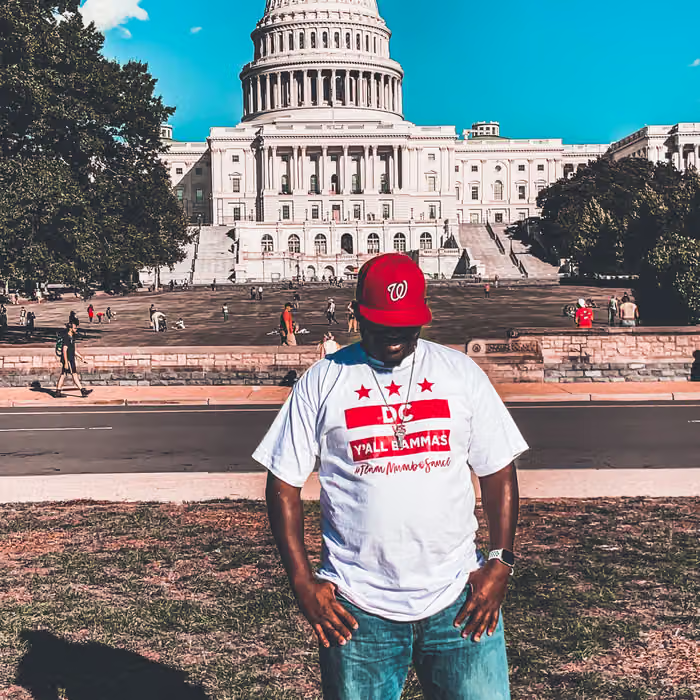
In every great cultural movement, there are individuals who refuse to let its stories fade with time. They become its historians, its ambassadors, and its most passionate defenders. Geese Da Goon is one of those rare artists.
More than a musician, he is a storyteller devoted to preserving the soul of Washington, D.C.’s roller skating culture, a vibrant community built on music, movement, tradition, and generations of shared experiences. Raised in a city where the pulse of Go-Go music echoes through neighborhoods and skating rinks serve as gathering places for families, friends, and dreamers, Geese Da Goon grew up immersed in a culture that would eventually become the foundation of his creative identity.
His latest project, SNAP CITY EP, stands as both a celebration and a cultural document. It captures the energy, pride, history, and spirit of the skating community that has shaped countless lives across Washington, D.C., Maryland, and Northern Virginia. Rather than simply creating songs, Geese Da Goon invites listeners into a world that many have never experienced firsthand, one where every skate move carries history, every rhythm tells a story, and every gathering strengthens a legacy passed from one generation to the next.
What makes his work especially compelling is its authenticity. Every lyric, every beat, and every story is rooted in lived experience. From his early exposure to an eclectic mix of music through his mother’s record collection to his lifelong connection with skating culture, Geese Da Goon has transformed personal memories into art that resonates with both longtime skaters and newcomers discovering the culture for the first time. His music not only entertains, it educates, preserves, and inspires.
As SNAP CITY EP continues to introduce audiences around the world to the culture he proudly represents, Geese Da Goon remains committed to a mission that extends far beyond music: ensuring that the people, traditions, and spirit of Snap City receive the recognition they deserve. In this exclusive interview, he reflects on his remarkable journey, the deep cultural roots behind his music, and the passion that drives him to keep the legacy of his community alive for future generations.

For readers discovering your work for the first time, can you introduce yourself and share how your journey into music and roller skating culture began?
I grew up where music was always playing. My mother had records, tapes, and 8-tracks, so I was exposed to all kinds of music from an early age. From Chaka Khan to Elton John, she had me listening to it all. I even remember percussion instruments around the house. Looking back, music wasn’t just something we listened to, it was part of the environment.
I also wouldn’t be a true Native Washingtonian, born in DC proper, and not mention Go-Go. It’s something about that sound that people outside of this area will never fully understand. It’s part of our DNA. Especially if you grew up near where a band was formed, practiced, or performed regularly. You can’t buy that. You can’t manufacture that. You either lived it or you didn’t.
Skating was the same way. My mother was a skater, so I grew up around rinks and skating culture. I didn’t discover skating later in life. I was raised around it. The music, the people, the traditions, all of that was already there long before I ever thought about making records myself.
The more I think about it, Go-Go is celebrating 50 years. So yes, I’m holding my head high when I talk about it. That’s part of who I am, part of where I’m from, and part of what shaped me musically.
Looking back, it’s not surprising that I eventually brought those two worlds together in my own music. Music was part of my upbringing. Skating was part of my upbringing. Eventually those two worlds met and became part of my creative identity.
SNAP CITY EP feels like much more than a music project. What inspired you to create an EP that documents and celebrates Washington, D.C.’s roller skating culture?
There are a lot of stories from this culture that should be told and documented. If they aren’t told and shared, then they are lost to the annals of time, and with them we lose a part of skate culture here in DC and, by extension, Maryland and Northern Virginia. We also lose part of my own origin story as a skater.
Some might say I’m fiercely loyal, maybe even overly proud, of my area and the way we skate. I’ll take that with my head held high and celebrate it because it’s definitely something to be proud of.
I was recently talking with another skater and we started comparing notes on all the events happening this month. The more we talked, the more I realized just how much of June is dedicated to celebrating different parts of our community. Between anniversaries, reunions, skate parties, celebrations, and events honoring people who helped build the culture, there’s something happening throughout the month.
It actually got me thinking. Over the last few years, I’ve noticed more and more of these events taking place in June. Looking at everything on the calendar, I found myself wondering if June has quietly become Snap City Month.
(Laughs.)
Nah, seriously though.
When you look at the number of anniversaries, reunions, skate parties, celebrations, and community events happening throughout June, it’s hard not to notice a pattern. I’m not talking about skating in general. I’m talking about the culture, history, music, traditions, and people that helped shape the DC, Maryland, and Northern Virginia style that many of us call Snap City.
Honestly, I’m going to have to talk to more skaters because I’m curious if they’re seeing the same thing. But standing where I am right now, it definitely feels like we’re spending a lot of June celebrating who we are and where we came from.
To me, that’s part of the inspiration behind SNAP CITY EP.
I wanted to contribute to preserving some of these stories, these experiences, and this culture. Because if we don’t tell our stories, nobody else will tell them the way we can.
I think the biggest thing people outside the skating community fail to understand is that they’re not just looking at people skating. They’re looking at a culture.
For many of us, skating isn’t just something we do.
It’s part of who we are.
Who are some of the artists, producers, or life experiences that have had the biggest influence on your musical style and creative vision?
I grew up where music was always playing. My mother had records, tapes, and 8-tracks, so I was exposed to all kinds of music from an early age. From Chaka Khan to Elton John, she had me listening to it all. I even remember percussion instruments around the house. Looking back, music wasn’t just something we listened to, it was part of the environment.
I also wouldn’t be a true Native Washingtonian, born in DC proper, and not mention Go-Go. It’s something about that sound that people outside of this area will never fully understand. It’s part of our DNA. Especially if you grew up near where a band was formed, practiced, or performed regularly. You can’t buy that. You can’t manufacture that. You either lived it or you didn’t.
The more I think about it, Go-Go is celebrating 50 years. So yes, I’m holding my head high when I talk about it. That’s part of who I am, part of where I’m from, and part of what shaped me musically.
I also cannot forget to mention the fellow producers and artists whose music became part of the soundtrack of skating culture. Da Blacksheep, KW Griff, Keezo Kane, T-Rell, Mz Nique, TJIB, Dame-O, Donte, Antidote, A-Trax, DJ Sykes, Ruezillent, DJ CJ, and many others all played a role in shaping my sound. I also want to acknowledge K-Blaze and D-Millz. May they rest in peace.
I know that’s a long list, but each of them contributed something. Whether it was production, energy, creativity, originality, or simply creating music that moved skaters, I learned something from all of them.
I would also be remiss if I didn’t mention NIZM. While working on this project, I spent time studying his wordplay and approach to writing. For this particular project, that influence definitely found its way into some of my lyrics and songwriting choices.
As far as my creative vision goes, it comes from all of it. The music my mother played. The Go-Go culture I grew up around. The skating culture that raised me. The producers, DJs, artists, and skaters who contributed to that community. They’re all part of the reason SNAP CITY sounds the way it does.
Roller skating has deep roots in Washington, D.C. culture. What do you think people outside the skating community often fail to understand about its impact and importance?
I think the biggest thing people outside the skating community fail to understand is that they’re not just looking at people skating. They’re looking at a culture.
They see people going around a rink. We see history, traditions, regional styles, music, friendships, and generations of skaters passing knowledge to one another.
I was recently talking with another skater and we started comparing notes on all the events happening this month. The more we talked, the more I realized just how much of June is dedicated to celebrating different parts of our community. Between anniversaries, reunions, skate parties, celebrations, and events honoring people who helped build the culture, there’s something happening throughout the month.
It actually got me thinking. Over the last few years, I’ve noticed more and more of these events taking place in June. Looking at everything on the calendar, I found myself wondering if June has quietly become Snap City Month.
(Laughs.)
Nah, seriously though.
When you look at the number of anniversaries, reunions, skate parties, celebrations, and community events happening throughout June, it’s hard not to notice a pattern. I’m not talking about skating in general. I’m talking about the culture, history, music, traditions, and people that helped shape the DC, Maryland, and Northern Virginia style that many of us call Snap City.
Honestly, I’m going to have to talk to more skaters because I’m curious if they’re seeing the same thing. But standing where I am right now, it definitely feels like we’re spending a lot of June celebrating who we are and where we came from.
To me, that’s the impact of skating. Communities don’t preserve things they don’t care about. The fact that people continue to celebrate, teach, and pass these traditions forward tells you everything you need to know.
The rink isn’t just a place to skate. It’s where friendships are built, where music becomes part of memories, where traditions are passed down, and where people find community.
For many of us, skating isn’t just something we do.
It’s part of who we are.
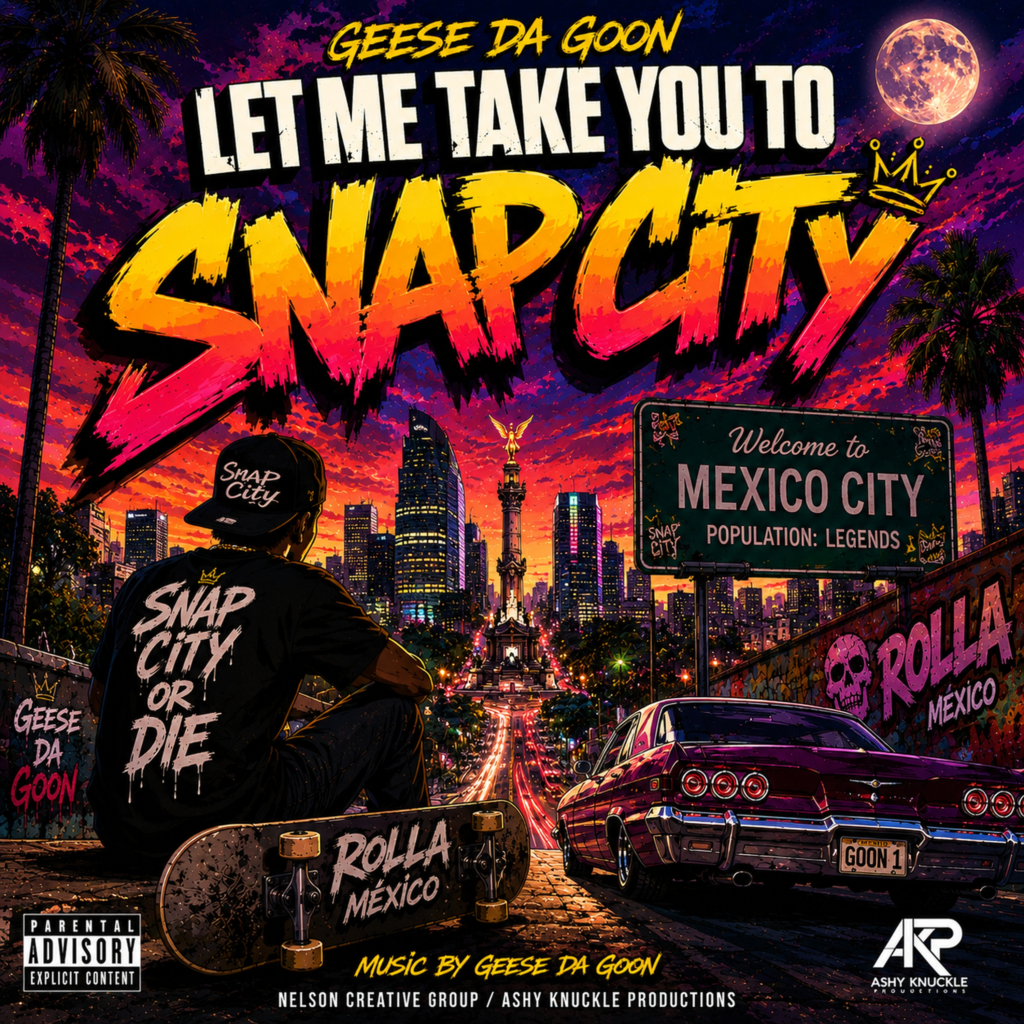
One of the standout tracks, “Rolla México,” has helped connect your music with skating communities beyond the United States. How does it feel to see a local movement resonate with people from different parts of the world?
To answer that question, I have to go back to 2001.
I told one of my mentors, Mr. Haywood “Woody” Blair (R.I.P.), that I was joining the Navy. He looked at me and said, “Bush” (that’s what I’m called here), “you’re going out into the world. You’re going to see a lot of different things. I want you to do one thing. Make sure the world knows how we skate here.”
That mission never left me.
Fast forward to April of this year. My little brother, DJ Prodigy, told me he had been asked to DJ an event in Mexico City alongside another fellow producer, DJ Techtrix. The moment he told me, I knew I couldn’t let him go down there without a song from me.
If you look at the full title of the song, it’s called “Let Me Take Y’all to Snap City.” Earlier in the year I had already released the original version, but there was another version I never planned on releasing. For whatever reason, that version jumped out at me. I decided to translate the lyrics into Spanish, which honestly made me nervous, and I sent the song with DJ Prodigy to Mexico.
Then I saw the videos.
I heard Rolla México.
I saw people skating to it.
I saw people dancing to it.
I even saw another DJ, Sourgrapism, making my little brother do a line dance with her to the song.
(Laughs.)
Honestly, that was worth the price of admission right there.
Man, you would’ve thought I won the lottery.
It felt unreal, but in the best possible way.
What made it special wasn’t just hearing my music in another country. It was seeing people connect with a culture that started thousands of miles away. In that moment, language didn’t matter. Geography didn’t matter. People were having fun, skating, dancing, and sharing an experience together.
When I think about it now, I realize I was simply doing what Mr. Woody told me to do all those years ago.
He told me to make sure the world knew how we skate here.
Now they know.
Looking back on your journey so far, what has been the most important lesson you’ve learned as an artist?
This has indeed been a journey.From being taught the basic rhythm of a song on a bongo by a friend of my mother’s, to getting suspended in the 6th grade for banging on desks just to give one of my classmates a beat to rap over.From going to Iraq and having my first DAW mailed to me so I could figure out how it worked during my off time.From making my first skate song that ended up on a skating mix CD.From participating in a skate producers contest and almost winning.
From DJs gatekeeping and refusing to play my music because I happened to have a strong opinion about a certain genre of music. (Laughs.) Side note: one DJ in particular has become my ongoing experiment. Every now and then I’ll send him something from a different genre just to see if I can break the theory. As a matter of fact, I’m entering one of those experiments into a songwriting contest, so wish me luck.
To now seeing my music, both as Geese Da Goon and as R.Nelson, travel to different parts of the world and continue growing every day instead of being confined to a room somewhere.
Looking back on all of that, I would say the most important lesson I’ve learned is to have absolute faith in yourself.
Not arrogance.
Not ego.
Faith.
There are going to be moments when nobody sees the vision except you. There are going to be moments when people tell you something won’t work. There are going to be moments when the results don’t show up as quickly as you’d like.
You have to keep going anyway.
I thank God and my mother for putting that mindset in me.
As I’m sitting here writing this answer, I’m honestly amazed by some of the things that have happened on this journey.
But to be honest, I feel like my journey is still starting.
As an independent artist, what has been the biggest challenge you’ve faced in building your career, and what lessons has that journey taught you?
You know, the terms “independent artist” and “music career” have been thrown around me a lot lately. To be honest, I never really thought about it like that.I think aside from some of the gatekeeping I’ve experienced over the years, the biggest challenge has been moving the music.
Making the music is one thing. Writing it, producing it, cleaning it up, mixing it, finishing it, that’s all fine and dandy.But unless you’re making music strictly for yourself, your family, and your friends, eventually you have to get it out into the world.
That’s where the real work begins.
You have to pitch your music to playlist curators.
You have to pitch your music to radio stations.
You have to pitch your music to bloggers and members of the press.
(Laughs.)
And let me tell you, that part is tough.
I think I’ve gotten more rejections from curators and bloggers than I ever got from women.
(Laughs.)
I’ve gotten so many rejections that I literally turned some of them into songs, and at this point I might end up releasing them as an album.
But here’s the thing. For every rejection, there’s an acceptance.
For every person who says no, there’s somebody else willing to give the music a chance.
And when those opportunities come, whether it’s a playlist, a radio station, a blog review, an interview, or somebody discovering your music on the other side of the world, it makes the effort worthwhile.
The lesson I’ve learned is that you have to be a good sport about it.
Celebrate the wins.
Accept the losses.
Take the rejections on the chin.
Then keep moving forward.
Matter of fact, I’m reading a rejection right now. How do you get rejected for a Deep House song when the person has playlists full of Deep House?
(Laughs.)
At some point you just have to appreciate the comedy in it.
8. Every artist experiences moments of doubt and breakthrough. Was there a particular moment when you realized that your music was making a real impact on people and the culture around you?
Wow.
I can answer this question in so many different ways.
Before a lot of people knew me as an artist, I was already making music. Much of it was living within the skating community and the rinks. Then I have everything that’s happened with my R.Nelson catalog. Then I have what I just experienced with Rolla México.
It’s honestly hard to narrow it down to one moment.
When I really think about it, I wouldn’t say there was a particular moment. It was a series of moments that showed me.
A skater reacting to a song.
A DJ playing a record.
A song making it onto a skate mix.
A review.
An interview.
A radio station giving a song a chance.
Someone quoting a lyric back to me.
Seeing people skate and dance to Rolla México in Mexico City.
Watching my music travel further than I ever expected.
Even losing in the first round of a skate producer competition called the Producer Face Off in 2019 was a moment. That probably sounds strange, but it showed me that I belonged in the conversation, even when I was bringing something completely different to the table. Sometimes even the setbacks teach you something.
Each of those moments by themselves might seem small.
But eventually they start adding up.
At some point you stop looking at them as isolated events and realize they’re all telling you the same thing.
People are listening.
People are connecting with the music.
People are connecting with the culture behind the music.
That’s when I realized what I was creating was reaching beyond me.
And honestly, I still get those moments.
Matter of fact, I had one recently. I saw people skating, dancing, and having a good time to Rolla México in Mexico City. Twenty-five years ago, one of my mentors, Mr. Haywood “Woody” Blair (R.I.P.), told me to make sure the world knew how we skate here.
Standing there watching those videos, I realized they did.
Now they know.
Looking beyond this project, how do you see both your music and the Snap City movement evolving over the next few years?
My music is a very loaded concept now.It’s evolving as I’m typing this answer, and I don’t see any signs of it slowing down. Only growth. At this point, I’m just along for the ride to see where it’s going to take me.
As far as Snap City goes, I’ve always said that every generation of skaters puts its own stamp on the style and the culture.
I’ve grown up in this culture and I’ve watched it change over the years.Right now, I’m watching the next two generations of skaters and producers out here grinding, putting in the work, learning their craft, and developing their own identities. They’re adding their marks to the culture, shaping it to fit their generation, and setting an example for the generations that will come after them.And to me, it’s looking good.
That’s what gives me confidence in the future of Snap City.
The culture isn’t standing still.
It’s evolving.
Just like it always has.
The music changes.
The style changes.
The people change.
But the culture keeps moving forward because each generation takes ownership of it and leaves something behind for the next one.
Honestly, I could ride off into the sunset happy knowing I was around long enough to witness that process.
To see the culture continue.
To see the next generation carry the torch.
To see where they take it next.
Finally, when someone listens to SNAP CITY EP for the first time, what do you hope they learn about the people, culture, and spirit that inspired it?
What I hope people learn is that Snap City is bigger than skating.
I want people to understand that behind every move, every song, every skate party, and every tradition are real people, real communities, and a culture that has been shaped over generations.
When I wrote “Let Me Take Y’all to Snap City,” I wasn’t just writing a skate song. I was inviting people into our world.
The first verse says:
“Born where the floor creak loud like threats,
Every wheel scrape echo old regrets.
We don’t skate cute, we carve intent,
Every glide got pressure, every stop got rent.
Go-Go drums like a pulse in the chest,
Miss a pocket here? You get exposed, not blessed.
Mumbo Sauce on my fingers, grease on my soul,
Chicken box cold but my roll stay whole.
Your style loud but it hollow inside,
Ours whisper danger every time we slide.
This ain’t for clicks, this for bloodline ties,
Snap City skating—either learn or die.”
Even though the second verse is more personal to me, and the intro is a taunt, that first verse is really setting the stage.
It’s telling you that you’re going to see D.C.
You’re going to see Baltimore.
You’re going to feel our rinks.
You’re going to hear our music.
You’re going to experience the culture, pride, history, and personality that helped shape us.
The more I look at the lyrics now, the more I realize I started out writing a song, but somewhere along the way it became an anthem.
I never intended for that to happen.
It’s strange.
The more I reflect on it, the less the song seems to be about me and the more it seems to be about the culture, the people, and the places that inspired it. Even the second verse, which is more personal, is ultimately about what this culture did for me and how it helped shape the person I became.
I want people to understand why we’re proud of it.
I want them to understand why we protect it.
And I want them to understand why we celebrate it.
Most of all, I want people to stay long enough to learn something.
Not just about skating.
Not just about music.
But about a place called Snap City.


